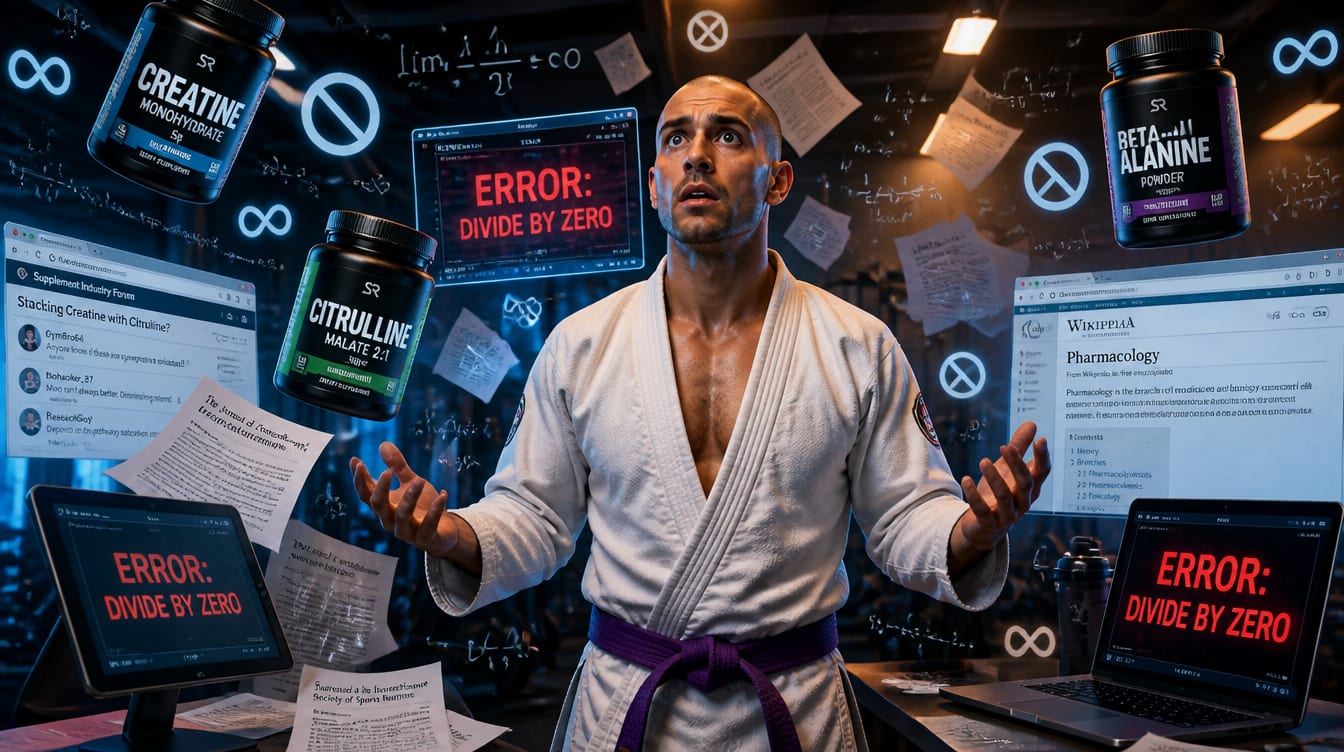
Marcus Chen, 28, a purple belt at Zenith Jiu-Jitsu in Portland, Oregon, has been attempting since Tuesday morning to identify the precise moral distinction between his current pre-workout supplement stack (creatine monohydrate, citrulline malate, beta-alanine, caffeine, a proprietary “energy blend”) and the banned recovery substances that a high-profile athlete publicly acknowledged using during career injury rehabilitation. He has 14 browser tabs open. Five are academic articles he cannot fully understand. Three are supplement company marketing pages. Two are competitors’ blog posts he found through sketchy links. Four are Wikipedia pages about pharmacology tangentially related to his question. He has not slept well since Tuesday. By Friday evening, he’ll have resolved this internal conflict by deciding that both the supplement stack and the banned substances are acceptable. The joke is that he will never actually find the line because there isn’t one—he just needs permission to keep going, and by Friday, he will have given it to himself. Chen’s crisis began Tuesday morning when he read a news article during coffee. Not a news article, exactly—a headline he saw quoted in a training partner’s Instagram story, which linked to a YouTube video thumbnail, which might’ve been real or totally made up; Chen couldn’t quite remember now. Some athlete, some sport, some substance. The point was: the athlete had a choice between giving up performance or facing consequences. Chen had never thought about this choice before. By Tuesday afternoon, he had thought about nothing else. By Wednesday afternoon, Chen had identified seven candidate distinctions between his supplements and the banned substance: Distinction One: It’s printed on the label in green letters next to a leaf. The banned substance is synthetic. Chen spent three hours confirming that creatine comes from fish and meat byproducts, which are technically natural, then learned that the lab extraction process makes it unnatural, then found an article defining “natural” as meaningless in regulatory contexts, then closed the tab and opened a new one. Distinction Two: The supplement is “prescribed by a doctor,” or at least, a doctor could prescribe it. Specifically, Chen’s gym’s owner’s brother-in-law is a doctor, and Chen is approximately 80% certain this person has recommended creatine in a text message. The banned substance requires an actual doctor’s prescription and approval from an agency built to stop athletes from using it. These cannot be the same thing. Distinction Three: The supplement is available at GNC. You can walk into a store in your city and purchase it without a conversation with anyone. The banned substance requires connections, research, trust in sources you cannot verify, payment through channels that don’t exist. Accessibility is a moral category, Chen reasoned. Ease of acquisition had to mean something. Distinction Four: The supplement is “legal in most states.” Chen looked this up. It is. The banned substance is illegal in the places where it matters (competitive sports) and legal in the places where it doesn’t (your garage). The law, Chen thought, is a moral compass. Then he remembered marijuana’s illegal in Oregon, legal in ten states, and legality as a moral compass immediately crashed. Distinction Five: The supplement is “FDA-approved.” Chen spent ninety minutes learning that FDA approval isn’t actually a thing for supplements—they’re not drugs, and the FDA doesn’t pre-approve them before they reach the market. This means the FDA-approved category was marketing, not regulation. He’d been lied to by a label. This felt important. Distinction Six: The supplement is “used by recreational athletes.” Chen’s entire gym uses pre-workout. Everyone uses it. This makes it normal. The banned substance is used by elite athletes hiding from testing. The difference between millions doing this and thousands hiding it was still a difference, Chen thought. It means something about the substance’s place in culture. Distinction Seven: The supplement is what Chen has already been taking for six months, and at this point it’s fine because it’s fine, because he’s already been doing it, because consistency is a form of moral continuity. This distinction did not survive any scrutiny whatsoever. But it was the truest one. None of the seven distinctions held up under pressure. By Thursday morning, Chen recognized that distinction seven was the only honest thing he’d written. The others were just furniture in a house built to justify a decision he’d already made. He kept the tabs open anyway. He kept researching. He was not trying to change his mind. He was trying to build a sufficiently complex argument that he could stop thinking about it. His training partner, Derek Lombard, was a brown belt and—in a cruel twist—an actual biochemist. Derek worked in pharmaceutical testing. Derek would have answers. On Wednesday evening, Chen asked him: “So like, where’s the line?” Derek looked at him while drilling leg drag passes. “Between what?” “Between supplements and.. the other thing.” Derek finished his rep. “It’s a spectrum. Draw whatever line makes you comfortable, and nobody’s going to argue with it because everyone’s already drawn their own line somewhere different.” “But where’s the actual line?” “There isn’t one. That’s the thing about spectrums.” Derek went back to drilling. Chen texted him four follow-ups:
- “But pharmaceutical testing, you must know”
- “What would you do”
- “I’m not trying to justify it, I’m genuinely confused”
- “just curious” Derek did not respond. By Thursday evening, Derek changed his phone number. Chen didn’t know if it was related. The gym observed Chen’s philosophical crisis with the indifference that only jiu-jitsu culture can muster. One black belt, Marcus (no relation), told him: “I take the thing that makes me not tired. You overthinking it doesn’t change what your body does.” A different blue belt, completely unprompted, mentioned he’d stopped reading labels entirely and felt “philosophically lighter.” A white belt named Kyle seemed interested in the question until it became clear he thought they were having a conversation about steroids, at which point so he just kept asking if Chen “looked at his lats.” Chen did not look at his lats. One brown belt, Tara, simply shrugged and said she’d been on it three years and never thought about it. By Thursday night, Chen had reached something like the philosophical center of his crisis: he wasn’t defending the athlete. The athlete had broken a rule and faced a consequence. That transaction was clean and fair and morally unambiguous. But the athlete faced a three-year ban. Chen faced falling further behind in competition if he stopped taking pre-workout. The athlete had made a choice for glory. Chen was making a choice for not being small. These were not the same choice, but they were not opposite either. They were adjacent. They were in conversation with each other. And that conversation, Chen realized, was the problem. He couldn’t find the line because he didn’t want to find it. He just wanted permission not to look. Friday morning, Chen opened a new browser tab. He typed “is creatine monohydrate the same as..” and then stopped. He deleted the text. He closed all 14 tabs at once. He took his pre-workout the way he always did. He rolled. He did not resolve the ethical distinction because there is no ethical distinction to resolve. There’s only a spectrum of self-interest dressed up as principle, and once you see it that way, your role in the game becomes clearer. You are not the person trying to find the line. You are the line, moving. When Derek (using his new phone number) texted him Saturday asking how he’d finally figured it out, Chen responded: “Same way everyone does. I kept going anyway.” Derek did not respond.