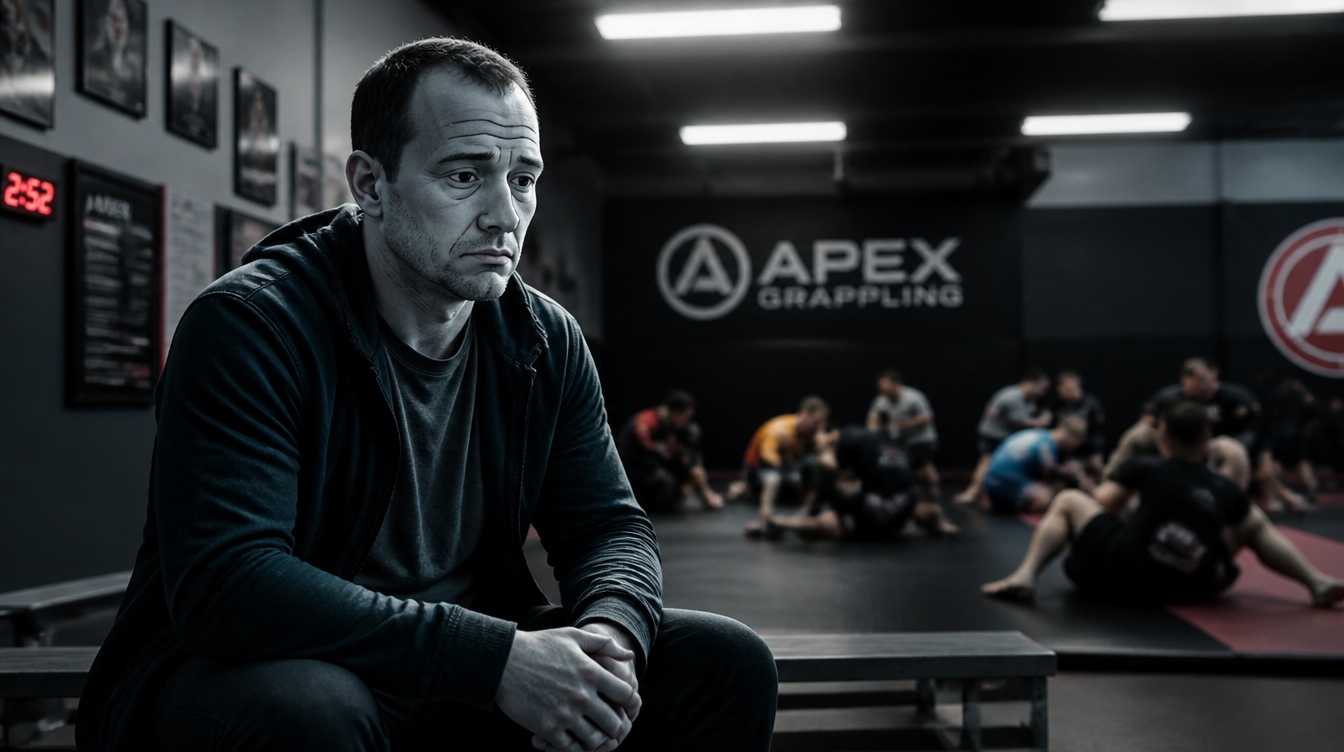
Darren Pellman, 37, three-time regional submission wrestling champion from Scottsdale, Arizona, announced his retirement from no-gi grappling on June 14 after nineteen years of competing. He had trained six days a week at Apex Grappling for the last seven years, a schedule that left no room for hobbies, side projects, or conversations that didn’t begin with “When I competed..”
Within seventy-two hours of his final match—a loss, which complicated things—Pellman noticed a problem: the void left behind wasn’t a void. It was shaped, textured, and familiar. It was precisely the dimensions and exact weight of his entire personality.
By day three, he’d logged forty-seven hours in the Apex lobby—not rolling, not training, just existing in the space where he used to be someone. He began introducing himself to new students as “the former regional champ,” sometimes without being asked his name first.
Within two weeks, he’d delivered this introduction forty-three times.
His longtime training partner Jamie Costa documented the escalation: “First week, he’d mention it once per session. By week two, he’d lead with it. ‘Hi, I’m Darren, former regional champion. What’s your name?’ To people he’d trained with for eight years.”
Jamie paused. “Like we might have forgotten.”
His wife Rebecca noticed it immediately. During their first dinner together with no tournament to discuss or prepare for in thirteen years, she asked what was new. Pellman stared at his plate. “What do you mean?” he asked. She clarified: “In your life. What’s new in your life?” He thought for four minutes. “My knees don’t hurt as much,” he offered. That was the entire conversation.
Rebecca tried another angle: “What did you used to want to do, before you started competing?” Pellman had no answer because he had started competing at eighteen—before wanting to do anything other than competing.

His therapist, Dr. Anita Kern, ran a simple diagnostic in session three. She asked a series of open-ended questions about hobbies, interests, and passions. Every answer went back to grappling. Specifically his ranking.
When she asked what brought him joy, he said, “Winning regionals.” When she asked about his closest friendship, he said, “Jamie and I rolled together for nine years.” When she asked what he’d do if he won the lottery, he said, “Probably open a grappling gym and compete full-time instead.”
Kern looked up from her notes. “Darren, what do you like about yourself that has nothing to do with grappling?” He left after thirty seconds of silence.
The practical manifestations began immediately. Pellman applied to be an assistant instructor at Apex, hoping the role would fill the void. He taught a fundamentals class where he spent the entire hour correcting white belts on footlock positioning, explaining his own regional tournament strategy as context, and asking each student during their one-on-one corrections, “What are your rankings right now?”
One student, a therapist named David who was there to stay active post-divorce, said, “I’ve been training for three weeks, Darren.” Pellman responded with genuine concern: “Right, but what’s your goal?” David said, “To feel less alone.” Pellman considered this and said, “I mean, the regionals are in November. You could probably compete by then, maybe place.”
His Instagram became an archaeological dig of his own identity erasure. Pellman posted tournament footage from seven, eight, even nine years ago. He captioned one video from 2017—a match he’d won, a moment he’d already won in real life and then won again in memory a thousand times—with “Still got it.” The post received two engagements: a like from his mother and a like from a bot farm. He checked it thirty-seven times that day, waiting for comments that would confirm his existence.
By week four, he’d tried five different “retirement identity” experiments.
First: “Fitness influencer.” He bought equipment for a home gym and posted selfies. The captions read like obituaries: “Building champions,” “Legacy work,” “Next generation.” His follow count stayed at 237.
Second: “Mentor figure.” He texted former competitors asking if they wanted training advice. Most didn’t respond. One, a brown belt named Sophia, replied: “I’m competing in Kansas next month. Maybe you could tell me what I should think about?” He responded with a seventeen-point analysis of her competition history and what matchups to expect. She texted back: “I just need to know if I should feel confident.” He said, “That depends on your ranking.”

His daughter Maya, eight years old, asked an innocent question that broke something: “Dad, what do you like to do?” Pellman had no answer. He’d spent her entire life traveling to tournaments, training, and recovering from training. In her memory, he’d never done anything else.
He tried: “I like grappling.” She said, “But you don’t anymore.” He said, “Right.” She asked, “So what do you like?” The question hung there, unanswered, for three minutes.
The most revealing moment came on day thirty-five. Pellman began filling out an application to compete at a smaller tournament—not because he felt called to competition, but because forms made sense to him. Name. Age. Belt level. Tournament history. Previous placements. These categories had defined him so completely that an actual human conversation (where you’re supposed to have interests, opinions, and dimensions) felt impossible. But a form? A form asked only the questions he could answer.
When Rebecca found the registration draft, she asked if he was serious about returning. “No,” he said. “But look.” He showed her the form. “Do you see? It’s asking me who I am. And I have answers to that question. Only that question, but I have answers.”
She read it. Name, age, belt level, tournament record. “Darren,” she said carefully, “that’s not who you are. That’s what you did.” “Same thing,” he said.
He returned to Apex Grappling two weeks later—not to compete, but to sit in the lobby again, where he belonged, where the dimensions of the void matched the dimensions of his presence exactly. New students would arrive, and Pellman would introduce himself the same way: “Hi, I’m Darren. I’m a former regional champion.”
Some of them, the ones who hadn’t been there two months ago, would ask what he competed in. He’d describe his wins, his losses, his ranking progression. They’d nod politely and disappear to stretch.
One white belt, fresh from his first class, asked Pellman: “What’s the hardest thing about retiring?” Pellman thought about this honestly for the first time. “Realizing,” he said, “that there was never anything else to retire from.”