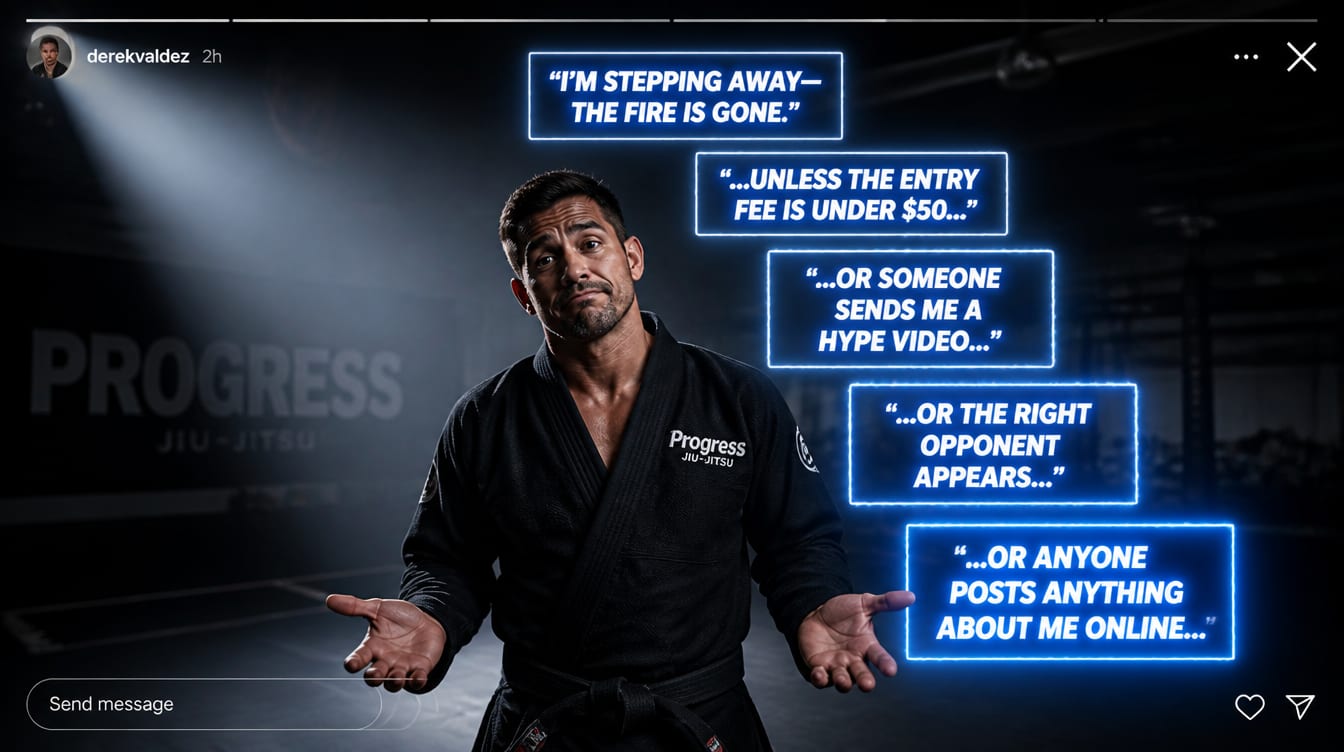
Derek Valdez, a black belt at Progress Jiu-Jitsu in Denver, posted an Instagram retirement announcement yesterday at 2:47 p.m. Mountain Time. The caption read: “I’ve made the difficult decision to step away from competition. The fire is gone. It’s just not for me anymore.” By 2:52 p.m., the fine print had been added: “However, if the right matchup comes along, or someone sends me a hype video, or the entry fee is under $50, or I’m coaching someone for a tournament, I might pop in. Also, if anyone posts anything controversial about me online.”
This is Valdez’s fourth retirement announcement in 18 months. The first three followed identical structural patterns. When Valdez posted his first retirement in December 2024, the response from his gym was respectful. Teammates liked the post. His instructor, Carlos Medina, sent a private message: “We’ll miss you on the mats.” Medina did not mention that Valdez had competed in the Denver Open three months later, where he submitted two purple belts and placed fourth in his division.
When asked about the contradiction between “stepping away from competition” and competing, Valdez clarified that he’d only entered the Denver Open because “the online registration glitched and charged me twice, so I figured I might as well use the entries.”
The second retirement came in March 2025, posted on Instagram Stories with a longer fine print section. This version included seventeen conditions under which he might return: right opponent, low entry fee, good time slot, high prize money, venue with good parking, tournament on a Friday, someone’s birthday competition, coaching opportunity, bet with a training partner, philosophical disagreement with someone online, someone publicly saying he was washed, someone publicly saying he was elite, his gym winning a team title, his gym losing a team title, “vibe checks out,” someone asking directly, or “I just feel like it.”
By August 2025, he’d competed in two IBJJF qualifiers and the Houston Fall Open.
The third retirement, posted in January 2026, included a spreadsheet—an actual attached Google Sheets document—that outlined a decision matrix. Rows: opponent ranking, entry fee, travel distance, temperature at venue, his gym’s recent performance, social media engagement on his posts, whether his teammates were also competing, and “general mood.” Columns: go/no-go, likelihood percentage, and “notes (be honest).” The intersection of “top-50 opponent” and “entry fee under $40” scored 94% likelihood of competing.
By May 2026, he’d competed in four tournaments and won his third match in the Submission Underground qualifier.

His teammates had stopped responding to retirement announcements by late spring. When Valdez posted the third one, the gym’s group chat produced a single reply from purple belt Marcus Chen: “Cool, cool.” Medina, his instructor, now just reacts with a thumbs-up emoji and moves on.
“I stopped reading them after the second one,” Medina said during Wednesday evening’s advanced class, while Valdez was actively drilling arm drags in the corner. “At this point, the retirement is just content. It’s part of his posting schedule, like how other people post workout updates.”
The fine print on yesterday’s fourth retirement has grown to 340 words. In addition to the previous conditions, Valdez added: “if someone challenges me in the comments,” “if the venue has air conditioning rated below 74 degrees,” “if my current W-L record ends in a four,” “if I haven’t competed in more than 90 days,” “if my gym is hosting the tournament,” “if any of my training partners are competing,” “if I have less than 18 hours of notice,” “if someone slides into my DMs with fight footage,” and “if I’m having what could reasonably be described as a ‘good day.’” The final line reads: “Also I’m training tomorrow at 6 p.m. if anyone wants to work guard passes.”
Online responses have shifted from congratulation to speculation. On his Instagram post, followers have started a betting pool in the comments: which condition will actually trigger his return? Current odds favor “someone sends me a hype video” at 6:2, with “low entry fee” at 5:1 and “coaching opportunity” at 7:2.
One follower, using the handle @BJJTactician, wrote a 400-word analysis comparing Valdez’s four retirement timelines against grappling competition calendars, concluding that “Valdez’s retirement-to-return ratio is statistically indistinguishable from random chance. He may actually be the world’s first data-driven grappler who uses retirement announcements as a scheduling tool.” The comment got 340 likes.
Progress Jiu-Jitsu has begun selling t-shirts that read “Derek’s Fourth Retirement (2026) – Merch While Supplies Last – Proceeds Go to Whoever Gets Him to Compete.” The gym’s accountant, Brenda Kowalski, confirmed the shirts are “technically merchandise,” which means they need separate SKU codes in their bookkeeping system.
“I’ve had to create a new account called ‘Retirement-Adjacent Revenue,’” she said. Sales have been modest—fourteen shirts sold—but the gym has used the proceeds to buy a new timer for the front desk.
Valdez bought two shirts.

The real escalation came when a rival gym in Boulder created a satirical “Retirement Counter” on their website, tracking Valdez’s announcements like a doomsday clock. It currently reads: “Days Since Last Retirement Announcement: 1.” The counter resets every time Valdez posts.
When Valdez was informed of the counter, he texted a teammate: “Should I retire again to break their counter?” The teammate did not respond.
Another teammate, white belt Jacob Torres, asked: “Is he actually competing tomorrow or is that part of the retirement?”
What Valdez created—maybe by accident, maybe on purpose—is a performance art piece about how retirement announcements became performative. Real retirements exist. People do walk away for legitimate reasons: injury, family, financial pressure, burnout. But in Valdez’s case, the retirement announcement has nothing to do with actually stopping. The announcement is now its own event, separate from anything happening on the mats. He retires, confirms his retirement through fine print negotiations, then trains and competes as if the retirement never occurred.
When asked whether he would actually stay retired this time, Valdez paused.
“I mean, I don’t know what ‘retired’ even means anymore,” he said. “Like, if I post that I’m retired but I’m still training, am I retired? Is it about competing or is it about the announcement? I think the announcement is the real thing. The competing just happens after.”
Mediana interjected: “He’s training tomorrow at 6 p.m. He’s definitely not retired.”
Valdez has already scheduled his fifth retirement announcement for mid-July. The fine print is expected to be longer.