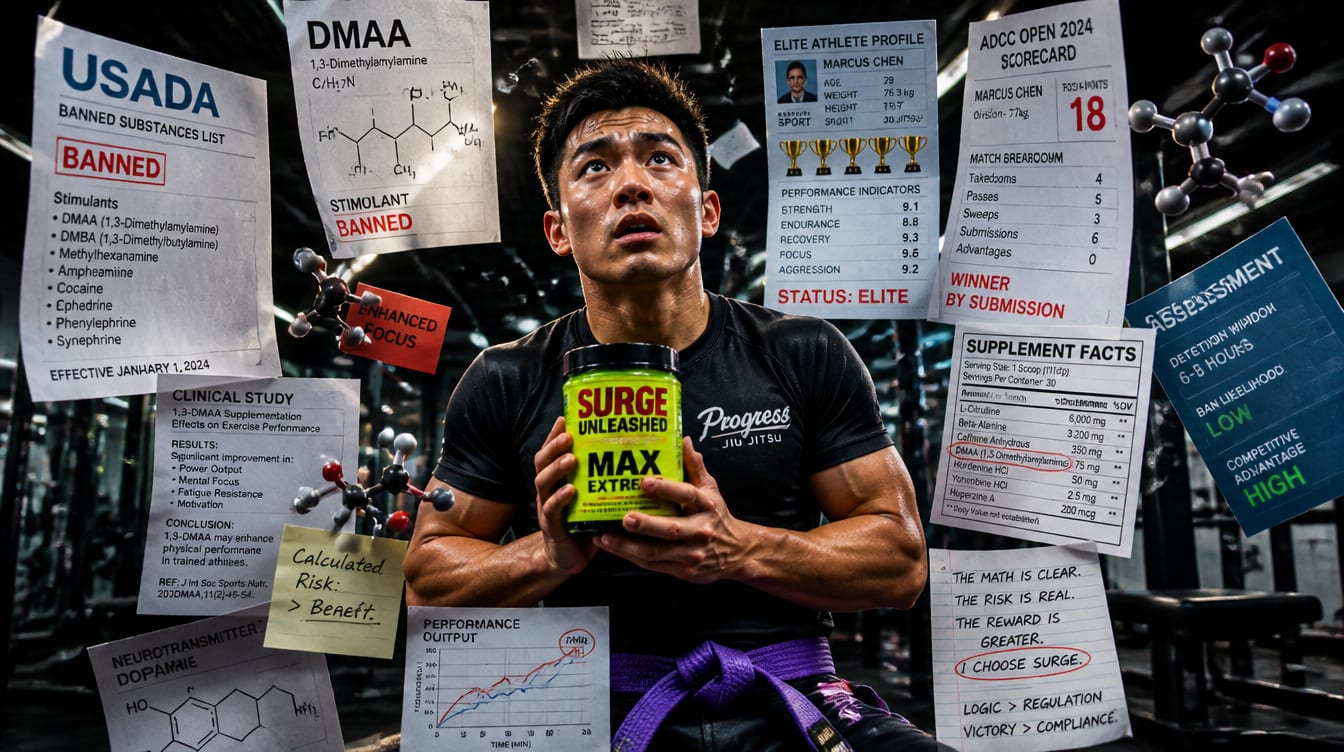
Marcus Chen, a 29-year-old accountant from Westbrook, Connecticut, discovered last Tuesday that his pre-workout supplement contains three compounds flagged on international athletic banned substance lists and concluded this makes him, biochemically speaking, an elite-level grappler. Instead of ditching the product, Chen spent the past four days telling anyone within earshot at Dominion Jiu-Jitsu that his regimen now aligns him with pro athletes’ pharmacological profiles, though his attempts to frame this as an advantage are hampered by the fact that he still gasses out during five-minute rolls. “If Melqui’s doing it, I’m basically doing it,” Chen told his training partner Derek on Wednesday while holding his neon-yellow container of “SURGE UNLEASHED MAX EXTREME” aloft like a diploma. Derek stared at the label, then at Chen, then back at the label. “You’re reading this wrong,” Derek said. Chen was not reading it wrong about the banned substances. He was, however, reading it very wrong about what this implied regarding his athletic status.
The discovery occurred at 11:47 p.m. on Tuesday when Chen, preparing his morning shake, finally read the supplement facts label he’d ignored for six months of purchase, refrigeration, and consumption. The label included L-carnitine (common amino acid, completely legal), beta-alanine (common amino acid, completely legal), and DMAA (banned by the FDA in 2013, banned by USADA, banned by most sport governing bodies, and the reason the product carried a warning label in small text that Chen interpreted as “intensity guarantee”). Rather than call his doctor, search for an alternative supplement, or simply accept that he’d unknowingly consumed a banned substance and move on with his life like a normal person, Chen took a screenshot of the label, searched “USADA banned substances elite athletes,” cross-referenced the three compounds, and began constructing an elaborate narrative where he was operating at professional standards without having made a single meaningful change to his training.
“He showed me the label at 6 a.m. on Wednesday,” said Derek Paulson, 31, a fellow purple belt at Dominion and the closest thing Chen has to a training partner who hasn’t actively started avoiding him. “He was like, ‘Look. Three of these. USADA flags these. I’m basically taking what Melqui takes.’ I told him that Melqui doesn’t take DMAA because DMAA is illegal, dangerous, and also because Melqui is a world-class athlete with a coaching staff, medical supervision, and a reason to care about these things. He said, ‘Exactly. I have that too.’ He gestured at his smartwatch, which he uses to track steps, as if those three things were equivalent.”

The reclassification intensified. By Wednesday afternoon, Chen began posting in the Dominion group chat with the confidence of someone who’d discovered a loophole in genetics. His first message read: “New theory: there is no gap between me and elite athletes. We’re all consuming the same chemical cocktail. The difference is they have better genetics and training volume, which is honestly just a motivation thing on their part.” His second message, sent at 2:14 p.m., contained a side-by-side comparison of three different supplement stacks he’d found online, with handwritten annotations claiming they were “practically identical.” The stacks he was comparing were for different athletes in different sports, purchased by different companies, written years apart. His research methodology was approximately as sound as his supplement selection process.
Derek responded with a single question mark. Chen interpreted this as engagement and doubled down. By Wednesday evening, he pivoted his theory once more. He was no longer claiming to be elite. Instead, he was claiming to be honest. “Look, everyone at this level is on something,” he wrote to Derek in a direct message with the tone of someone sharing classified information. “The difference between me and guys like Melqui is that I’m transparent about it. When I get tapped by a brown belt, I can say it’s because the pre-workout timing was off, not because he’s better trained. That’s integrity.” Derek didn’t respond to this message for seventeen hours. When he finally did, it was a single thumbs-down emoji.
Dominion’s head instructor, Professor Carlos Medina, found out on Thursday morning when Chen arrived for open mat and immediately approached him to discuss what Chen described as “comparative performance metrics in supplement-adjusted populations.” Medina listened to the entire twelve-minute presentation without interrupting—a sign of either patience or despair. When Chen finished, Medina paused and said, “You know you’re still not passing guard, right? You got swept by a three-month white belt last week.” Chen nodded. “Not yet. But chemically speaking, the potential is there. The ceiling has been raised.”

By Friday morning, Chen began researching whether other members of Dominion might unknowingly be on USADA-flagged supplements. He approached three different purple belts and asked them to read their pre-workout labels. Two of them didn’t own pre-workout supplements and had never owned pre-workout supplements. The third was in the middle of a triangle choke when Chen tapped him on the shoulder with his phone, asking him to check the label of his pre-workout at home. The purple belt, still in the triangle, simply sighed and submitted. Derek watched this interaction and decided to start arriving to open mat twenty minutes late.
Chen’s theory continued to metastasize like an untreated rash. On Friday evening, he sent Derek a video essay he’d constructed from YouTube clips, royalty-free background music, and text overlays. The title: “Elite Athletes DON’T Want You to Know This About Pre-Workout.” It was four minutes long. It contained no original footage. No interviews. No actual evidence beyond screenshots of ingredient labels and a personal philosophy about chemical equality. The conclusion was that Chen should now be considered for higher-level competition because “the chemical ceiling has been equalized across all of us.” Derek watched the first forty-five seconds and texted back, “Brother, you placed third in a local white belt tournament in 2023. They gave everyone who participated a medal.”
When Chen tried to upgrade his competition status for an upcoming local tournament on Saturday, the registration form asked him to confirm his belt level. He put “purple belt” in the form, then immediately called the tournament organizer to discuss his “special category.” The organizer didn’t call back. As of Saturday evening, Chen is scheduled to test for his brown belt within six weeks, which neither he nor any Dominion instructor has actually discussed or scheduled. He has, however, decided that when he inevitably fails, it will be a decision made by people who are “threatened by transparent doping disclosure” and not a reflection of his actual skill level. He has already drafted a lengthy email to the testing professor explaining the situation, complete with screenshots of banned substance lists and a personal philosophy about chemical equality across all training populations. He hasn’t sent it. Derek has begged him not to send it. Chen is still considering sending it. He sent a draft to Derek anyway. Derek didn’t read it.