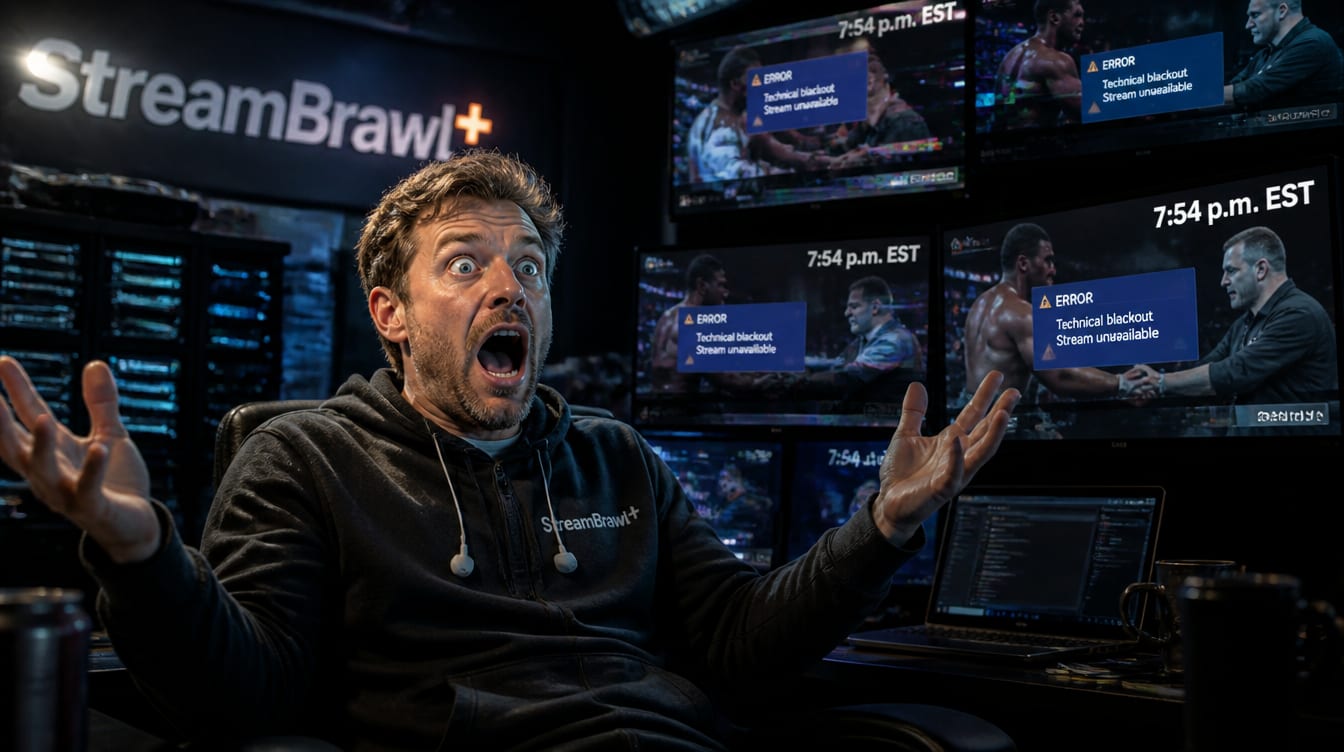
The Meridian Grappling Invitational’s main event between purple belts Devon Massey (27, Austin, Texas) and Curtis Larrabee (26, Portland, Oregon) aired exclusively on StreamBrawl+, a subscription service founded four months prior by tech entrepreneur Marcus Whelan (38, Venice Beach, Los Angeles). Whelan had completed a 28-minute introductory jiu-jitsu class at Equinox in January and immediately understood that grappling was “criminally undermonetized.” He secured $2.3 million in Series A funding from investors who had not watched a live grappling event.
On June 19 at 7:47 p.m. ET, the main event experienced a “temporary broadcast interruption” lasting 12 minutes and 34 seconds. When the feed returned at 7:59 p.m., the two athletes were shaking hands mid-mat while referee Tony Delgado documented Larrabee’s verbal submission from a triangulated heel hook he had been applying unobserved by the 3,847 paying subscribers. The live chat had continued uninterrupted during the broadcast blackout. One viewer with a phone-camera bootleg posted the critical moment at 7:54 p.m. with timestamped analysis. Another viewer reverse-image-searched the mat background and identified the specific light fixtures, then compared maintenance schedules and confirmed the submission landed within 90 seconds. By the time the official stream returned, the entire grappling community had collectively watched the finish four times through various Discord links and Telegram forwards. StreamBrawl+‘s own chat erupted with spoilers, technical breakdowns, and increasingly bitter sarcasm about paying $14.99 monthly for this specific handshake experience.
“We lost signal during the setup,” Whelan said via email six hours after the event concluded. “But we captured the athletes’ mutual respect and sportsmanship.” When asked if those 3,847 subscribers had funded this moment, Whelan didn’t respond. When asked why the platform’s redundancy system consisted of a single Ethernet cable suspended through a ceiling panel, Whelan noted that “infrastructure scales with user demand.” The cable had been unplugged by Derek (age unknown, “the HVAC guy”) at 7:45 p.m. to charge his iPhone 12. Derek had worked at the Meridian Event Center for seven years without ever receiving a briefing on StreamBrawl+‘s technical requirements. When asked if he’d thought about what the cable was for, Derek said, “It was the same color as my iPhone charger cable. Seemed like it was meant to share.” He continued unplugging it at every subsequent broadcast.

StreamBrawl+ announced the installation of “redundant failsafe technology” — a second Ethernet cable running through the same ceiling panel to the same outlet, approximately 18 inches from the original. Chief technology officer Nina Grosvenor (29, Stanford CS, zero grappling experience) had specified the failsafe architecture in a Slack message that read “idk maybe cable 2?” She was immediately promoted to VP of Infrastructure.
The platform offered subscribers a refund “in the spirit of transparency and customer-first values,” but only to viewers who submitted: a screenshot of their account login at 7:47 p.m. ET with metadata; a simultaneous timestamped screen-recording of the feed failing on a separate device; a written statement (minimum 200 words) explaining material degradation to their viewing experience; notarized photo proof of subscription payment visible in their account dashboard; a selfie with the StreamBrawl+ logo displayed at arm’s length, signed and dated; and a credit card ending in the last four digits matching their account file. The policy generated 47 refund requests. Forty-three were rejected for “insufficient documentation” or “unverifiable identity markers.” Four approvals went to duplicate accounts that had already been refunded for the previous month’s UFC Fight Night broadcast, which aired just the audio commentary from a ringside table (someone ordering appetizers, someone’s phone alarm, two commentators debating if tuna poke was “trending or dead”). One approval went to the deceased account of Richard Kohler (1952-2025), whose adult son had submitted on his behalf. That approval remains pending as of June 25.
Devon Massey, the competition loser, posted on Instagram 48 hours later: “Shout out to everyone who watched the full finish live. Apparently that was 3,847 subscribers simultaneously requesting refunds while rewatching bootleg angles in the live chat. Great energy, brothers.” The post received 612 likes, primarily from grapplers tagged in the bootleg clip group chats. Massey did not mention Curtis Larrabee, who had already secured a sponsorship deal with a supplement company based solely on the fact that the submission existed and had demonstrably occurred.

Curtis Larrabee appeared on a podcast four days later titled “Submission Breakdown: What You Didn’t Miss on StreamBrawl+.” The episode was downloaded 1.2 million times — approximately 314 times more frequently than the actual broadcast had been viewed in full. In the episode, Larrabee walked through the heel hook setup, weight distribution, and finishing mechanics. He said he hadn’t watched any of the six bootleg angles circulating on Discord and felt “really good about what we created together as a community.” When the podcast host asked whether that community included StreamBrawl+ subscribers, Larrabee said, “The best submissions transcend platforms.”
StreamBrawl+ announced a Q3 subscriber goal of 50,000 active accounts and $8.7 million in projected annual revenue. Run-rate projections put them at 2,100 subscribers by August, after accounting for June refunds and July churn from the UFC broadcast. The platform’s marketing materials, already printed for investor relations meetings, promised “exclusive coverage of competition grappling’s most intimate moments” — which had accidentally become technically accurate, as paying viewers now experienced grappling exclusively in slow-motion photographs accompanied by IRC-style live chat recaps.
By June 22, seventeen fan-run YouTube compilations with “official” in the title had been indexed in search results, collectively viewed 2.3 million times. StreamBrawl+ issued DMCA takedowns against all of them. The company then issued a public statement: “We’re thrilled that our content is so culturally significant that fans are creating supplemental materials to extend the StreamBrawl+ brand experience into new distribution channels.” Marcus Whelan was already architecting a failsafe for the failsafe — a redundant redundancy system involving a third Ethernet cable, a small cardboard sign in Comic Sans reading “DO NOT UNPLUG,” and a padlock. Derek had already found bolt cutters in the closet and left them propped against the outlet.