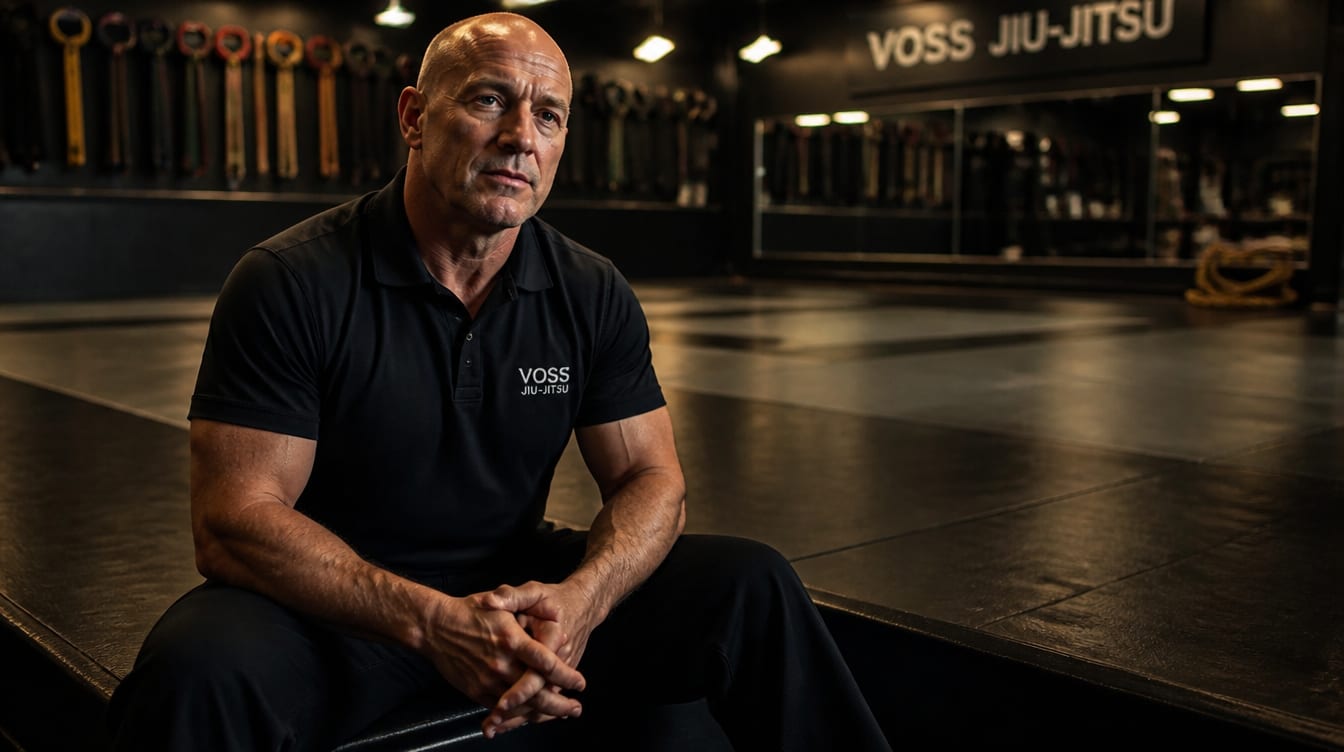
Derek Voss, 52, owner of Precision Grappling Collective in Willow Creek, Colorado, invented a new belt rule on June 12, 2026. He split blue belt into two tiers: “Temporary Provisional Blue Belt” and “Genuine Blue Belt.” The difference? Eye contact during drilling. Students who make eye contact with a partner while drilling get demoted, no matter how long they’ve trained or what belt they already had.
To get back to Genuine Blue Belt, students had to submit a written apology to Voss. He’d personally review it to make sure they showed “adequate contrition” and “demonstrated understanding of the infraction’s gravity.” (His words.)
Voss trained under what he says is a Carlson Gracie lineage dating back to 1998. But he didn’t explain the technical basis for the eye-contact rule.
When asked if staring at a drilling partner while executing an armbar was a technical flaw or a character issue, Voss said: “It’s both. Look at your own hands. Stop looking at their face. If you’re making eye contact, you’re distracted. If you’re distracted, you don’t respect the drill. If you don’t respect the drill, you don’t respect the mat.” Then he walked away mid-sentence without clarifying what “both” meant.
Within a week, 12 students had been flagged.
Ethan Mueller, 28, an insurance broker who’d been a blue belt for four months, made eye contact with his drilling partner Yuki Tanaka for 1.2 seconds—confirmed by security camera—while executing a sleeve-grip arm drag on Tuesday night. The next day, Voss flagged Mueller with a printed form under his windshield wiper: “Provisional Status Assigned — Eye Contact Incident (06/13/26, 6:47 PM, Armbar Sequence). Genuine Blue Belt can be reinstated upon written acknowledgment and retraining observation.”
Mueller, confused, asked if there was a technical problem with the armbar. Voss said: “The problem is your face was pointing at his face.”

By June 19, seven students had submitted apologies. Five were rejected for “insufficient humility.” One student used a semicolon in theirs—Voss flagged it as “pretentious punctuation indicative of underlying disrespect.”
Sarah Kessler, 34, a high school biology teacher, submitted a two-paragraph letter on the cognitive science of visual processing during motor learning—and why eye contact might actually enhance proprioceptive feedback during complex movements. Voss responded with one typewritten line: “Try again. Less thinking.” Kessler now trains at open mats at other gyms and told her friends Voss had “misplaced his authority somewhere between the arm drags and common sense.”
On June 16, Voss added another rule: students on Temporary Provisional status couldn’t roll, but could attend “observation drilling”—where they’d watch others drill without participating. So now there were gym members who showed up at 6 PM, watched silently for 45 minutes, and left without rolling.
On June 17, three of them—Marcus Webb, 35, an accountant; Jennifer Tran, 26, a software engineer; and David Okonkwo, 41, an electrician—asked if they could at least drill with each other in a separate room. Voss said: “No. Observation only. I need to see where the eye-contact disease spreads.”
By June 19, there was collateral damage. Two white belts who’d never been promoted caught themselves making eye contact during drilling and preemptively confessed to Voss. Voss promoted them to Temporary Provisional Blue Belt, then demoted them to white belt within 24 hours, then told them they’d have to “restart from clarity”—which meant “knowing where your eyes should not be.” Both white belts quit Precision Grappling Collective that week.
One left a one-star Google review: “I came to learn jiu-jitsu. I got a lesson in geometry.” Voss flagged it as “factually inaccurate and motivated by bitterness,” but it’s still live.
Voss created a shared spreadsheet tracking every student’s eye-contact history: incident date, duration in seconds, location on the mat, and “humility coefficient”—a metric he invented but never defined. He emails it to the whole gym every Sunday at 7 PM. It’s now 47 rows deep. Fifty-two percent of active members appear on it at least once.

Voss noted in his June 19 weekly email: “Provisional Proofings pending: 8. Retraining Observations scheduled: 6. Under Review for Final Denial: 2. New incidents this week: 3.”
On June 20, Robert Chen, 31, asked Voss if the eye-contact rule applied to rolling too. “Drilling seemed to be the specific context,” Chen said. Voss replied: “Rolling is different. In rolling, you should still avoid unnecessary eye contact, but your eyes can be anywhere your hands are.”
Chen asked about the difference between “necessary” and “unnecessary.” Voss said: “Your hands can be on their face. Your eyes can be on their ears. Your eyes cannot be on their eyes.” Chen nodded, thanked him, and transferred to a neighboring gym that evening.
Voss is now considering a third tier: “Black Belt Eye-Contact Exemption,” for which practitioners would need “mastery over the temptation to stare.” He hasn’t defined what that means, and nobody’s asked.
When asked if the system might fracture the gym’s community cohesion, Voss paused and said: “Fracture? No. Clarify. There’s a difference between jiu-jitsu people and people who do jiu-jitsu. My system identifies which is which.”
Three members canceled in June. Voss called them “self-identifying non-practitioners” in an email to the rest and didn’t process refunds.