Derek Chen, owner of Iron Peak Jiu-Jitsu in Scottsdale, Arizona, hired professional photographer Sarah Kim on May 12th to refresh the gym’s Instagram presence. Budget: $4,500. Kim was brought on to capture “the authentic, diverse, thriving community at Iron Peak”—to show prospective students “real people, real rolling, real transformation.” Chen wanted aspirational but grounded; Instagram-famous but not artificial. He gave Kim complete creative freedom across three weeks of shoots, morning classes through evening open mats. She delivered 94 processed images on June 9th. When Chen sat down to curate the gallery that evening, he opened the first batch of photos. Fifty-four images: same five people, different rolls. He checked batch two. Twenty-three more images, identical five people. Batch three: seventeen photos. He scrolled through the metadata. Sixty-two images without rotating a single face. Seventy-five. Eighty-three. By image 87, the pattern was undeniable: his gym’s “diverse authentic community” consisted entirely of five individuals in perpetual rotation. The math was stark: 87 of 94 delivered images (92.5%) featured the exact same five people. Not similar people. Not people with the same body type or belt level. Literally the same five humans, photographed in different gi colors, from different angles, in different positions, across different days—but unmistakably the same roster. When Chen pulled the full year’s roster list (82 active members), he realized his $4,500 investment had captured 6% of his gym. One person had appeared in 34 separate photos. Three of the five were people Chen had hired as “student ambassadors”—a term he’d invented two months prior to describe students who committed to attending class during photographer shoots and “looking natural.” He paid them $60 per month to do this. The other two were just students who happened to train during the three-week shoot window. They had no contract, no compensation, no idea they’d become the face of Iron Peak Jiu-Jitsu. Kim responded to Chen’s inquiry via email: “I shot what was in front of me. The same five people were in class during every session I scheduled. I didn’t see a brief that said rotate through the full roster. Derek’s notes said ‘capture the vibe, show authenticity, give these students a platform.’ I interpreted that as ‘follow these five.’ I could have asked, but assuming was faster.” She’d delivered according to her interpretation of a vague directive. Her invoice remained unpaid but pending. The Instagram engagement on the new gallery was 58 likes after three days. Forty-three of those came from gym-affiliated accounts—other students tagged or mentioned, Chen’s wife, his mother, and what appeared to be a bot Chen had activated in 2023 and forgotten about. Eight likes came from Kim’s own engagement-farming bot network. That left seven genuine organic likes from actual strangers scrolling the #ScottsdaleJiuJitsu and #ArizonaJiuJitsu hashtags. Chen’s accountant, reviewing the project cost-per-engagement, asked a single question: “So that’s $64 per like?” Chen didn’t respond. Later that day, she followed up: “Would drone footage fix this?” The five subjects eventually learned they’d become an accidental army in Chen’s marketing strategy. The three ambassadors—Marcus Pelletier, 29, an insurance adjuster; Tanya Rodriguez, 26, a fitness influencer with 7,000 Instagram followers; and Kyle Hernandez, 34, a longtime gym regular—immediately group-texted about renegotiating their contracts. Pelletier proposed raising the ambassador stipend to $100 per month “for professional modeling services and brand collaboration.” Rodriguez, who’d appeared in 19 separate photos across two weeks of training, countered with $85 per month “or usage rights to all images containing my likeness for personal commercial purposes.” Hernandez, who’d been training at Iron Peak since 2019 and had appeared in 27 photos entirely by accident, said nothing and began charging friends $5 for “introductions to the gym’s Instagram celebrity.” The two non-compensated subjects—James Park, 41, a blue belt who’d trained five mornings per week straight into Kim’s camera frame, and Monica Lahti, 28, a brown belt who led the Tuesday evening fundamentals class—were never contacted. They discovered their viral semi-fame by accident when a family member tagged them in an Instagram post. Park posted in the gym group chat: “Didn’t know I was famous. Do I get paid?” Kim, meanwhile, had started marketing the Iron Peak project as her signature work. She retitled it “Identity in Community Spaces: A Portrait Study of Consistency and Belonging” on her portfolio website and began pitching similar “exclusive community documentation packages” to other gyms across Phoenix and Scottsdale. She’d landed three preliminary meetings. Each pitch included the Iron Peak photos as evidence of her commitment to capturing “the true faces of a community.” No one had asked why every face looked identical across different gyms. Chen scheduled a follow-up call with Kim to discuss “next steps.” She proposed a documentary series: “Iron Peak Origins”—a 14-week, 280-image dive into the gym’s history, shot across morning, evening, and weekend sessions. “We’ll really capture the breadth this time,” she promised. When Chen asked if that meant rotating through different students, Kim said: “I’m thinking we go deeper with the five. Multiple angles, really understand their journey.” She quoted $7,200 for the full series. Three days later, Chen began investigating drone videography for the gym. Initial quotes ranged from $6,800 to $9,200 for a four-week aerial documentation package—“capturing the full energy and scale of Iron Peak’s operations from above.” When his accountant asked if the drone footage would include the broader gym community, Chen paused and said: “The drone can only fit so much frame time at that altitude. We’ll focus on the mat areas where the action is.” She noted that he’d already spent $4,500 on non-performing imagery and was now contemplating $7,500+ on additional investment from the same strategy. Chen scheduled a “special meeting” with the five ambassadors to discuss “brand evolution” and “the future of Iron Peak’s visual identity.” He sent an agenda: “Location scouting for drone shots. Availability for extended shoots. Q3 commitment levels.” Pelletier immediately countered with a new proposal: “$150 per month for ambassadors, with a signing bonus of $200 and usage rights to any imagery containing their likeness.” Rodriguez asked if the drone footage was going to be “more of the same five” or if “other people might actually get featured this time.” No one answered. By June 28th, Chen had spent $4,500 on professional photography that captured zero new perspectives. He was contemplating another $7,500-$9,200 on drone footage. He’d hired three people at $60/month to be authentic. He had seven real organic social media engagements. His accountant had stopped asking questions. His ambassadors had organized a negotiating committee. His photographer was pitching the project to other gyms as a success story. And Iron Peak’s Instagram grid remained, for all practical purposes, a five-person rotation on infinite loop. “Next quarter,” Chen told his accountant, “we’re definitely going to branch out to video content.”
Gym's $4,500 Photography Refresh Features Five People
A jiu-jitsu gym owner hires a professional photographer to capture diverse community. Instead, 94 images feature the same five people in every shot.
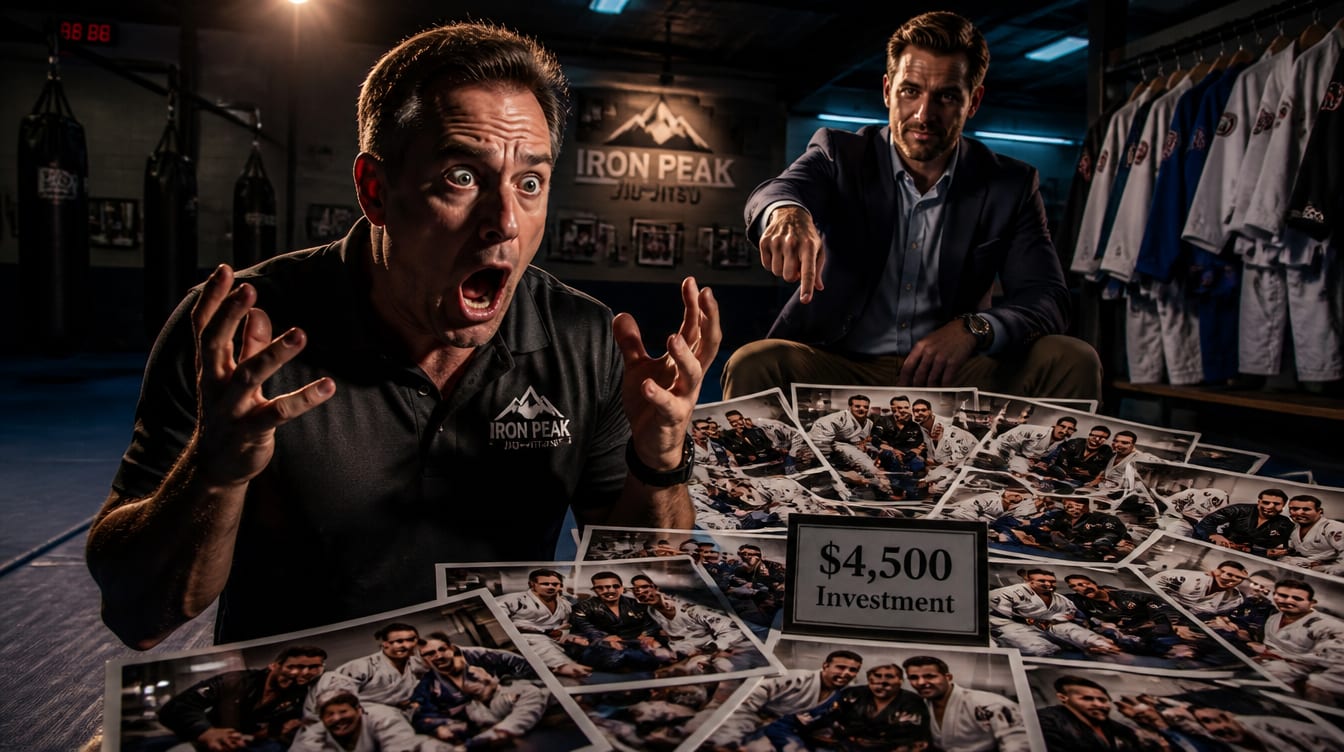
Image generated by AI / BJJ Digest
AI-generated satire. This article was written by an AI trained on years of BJJ content. None of this is real news. Do not cite The Porra in legal proceedings, belt promotions, or arguments with your professor.