Marcus Fenn, owner of Westside Combat Academy in Raleigh, North Carolina, introduced a new “Combat Readiness Certification” program this week for $2,000. The curriculum: attend five classes, roll with at least two instructors, maintain a positive attitude, and submit a 200-word statement about your grappling future. Fenn anticipates demand from serious grapplers seeking external validation. Twelve students have already enrolled. The certificate, printed on cardstock and personally signed by Fenn, arrives in a laminated folder. Nobody at the gym has actually attempted to use it anywhere. The timeline for completion is flexible—anywhere from five weeks to five months, depending on class attendance. Students must maintain what Fenn calls “appropriate effort,” which, upon clarification, means showing up and not verbally complaining during rounds. This does not apply to involuntary sounds (tapping, groaning, the occasional “Jesus Christ” escape from a particularly committed heel hooker). Fenn’s head instructor, David Lowenstein, will grade students on what he describes as “heart” and “attitude.” They’re not defined numerically. Both are noted as “evident” or “needs improvement” on the grading rubric, which Fenn drew up on the back of a printer jam notice. “People spend their whole lives not knowing where they stand,” Fenn said during a Wednesday evening class, interrupting positional drilling to explain the program to a captive audience who’d paid their monthly membership. “With this certification, they know. They have proof they completed a certification program. It’s $2,000, and they know it.” When asked what the certification proves—technical proficiency, competitive readiness, resistance to pressure—Fenn replied, “It proves they showed up and didn’t complain about it. That’s a real achievement.” He then returned to correcting a white belt’s grip, which had nothing to do with the certification. The certificate is a 6-by-9-inch cardstock document featuring Westside Combat Academy’s logo (a silhouette of a person mid-armbar, drawn by Fenn’s nephew who doesn’t train). The text reads: “This certifies that [Name] has completed the Westside Combat Readiness Certification Program and is recognized as Combat Ready by Marcus Fenn, Proprietor.” Below that, a paragraph Fenn composed attempts to explain combat readiness: “Combat readiness is a state of mind. It is the acknowledgment that you have attended five classes and rolled with at least two people without expressing significant reservation about their pressure.” Lowenstein, who’s been teaching at Westside for six years and holds a coaching certification from the IBJJF, was not consulted about the grading criteria. He learned about them by overhearing Fenn’s explanation to a curious student in the hallway. “Marcus said it was about heart and attitude,” Lowenstein recounted, then returned to his coffee, which had gone cold during the explanation. When pressed on how he’ll actually evaluate these intangible qualities in a standardized way, he considered the question for a long moment and then shrugged with the weariness of someone who works in education. “I guess if someone shows up, doesn’t tap fast, and rolls with two of us, I’ll check the boxes.” He hasn’t checked any boxes yet because, as of Thursday afternoon, zero students had actually scheduled their first certification classes, though twelve had paid in advance. Of the twelve who’ve paid upfront, ten chose installment plans ($500 today, $500 in three months, $500 in six months, $500 whenever they remember or whenever Fenn texts them). Two paid in full with credit cards they will probably dispute within the return window. The oldest student in the cohort is Craig Delancey, 47, an insurance adjuster and divorced father of two who joined Westside three months ago and is still not convinced he enjoys rolling so much as he’s trapped in an extended endurance test. When asked why he paid $2,000 for a certificate nobody recognizes and that brings no competitive advantage, Delancey explained matter-of-factly, “Marcus said it would boost my confidence. He also said it was non-refundable and there’s a $200 transfer fee if I want out.” Delancey has attended two classes in three weeks, both times limping on his left side and mentioning his rib. The 200-word statement of intent is where Fenn imagines differentiation will emerge. Students are instructed to write about their grappling future, their “philosophy of combat,” and “what this certification means to you.” Sample prompts that Fenn emailed out include: “How do you see yourself as a grappler five years from now?” (not mentioned: five years ago, none of these people were grapplers) and “What does ‘heart’ mean to you?” (Fenn admits he didn’t define it first). Delancey’s draft statement was two paragraphs about his lower back pain and a lingering suspicion that the whole thing is a financial mistake. When asked whether the certificate would be recognized by IBJJF, major competition promotions, the United States government, or any entity beyond Westside Combat Academy’s immediate zip code, Fenn paused. Then he explained, with the tone of someone correcting a fundamental misunderstanding, that “It’s recognized by Westside Combat Academy. That’s who’s certifying it. It’s not meant to be general currency. It’s a Westside thing.” This is technically accurate but also technically useless. When asked if Westside’s liability insurance covers legal claims made by someone who holds a fraudulent-looking certificate printed on cardstock, Fenn said he hadn’t thought about it and didn’t want to. When asked if the certificate has any legal standing under North Carolina state law, he changed the subject to a new program he’s designing: a $3,000 “Advanced Combat Readiness Recertification” that requires six classes, a statement of continued intent, and proof of “ongoing humility.” The real value, Fenn explained, lies in the external validation. “People want to know they’ve accomplished something. A belt promotion takes years. A certificate takes five classes.” He paused. “Same thing, emotionally.” Delancey has tentatively scheduled his first certification class for July 15th, pending confirmation of schedule, approval from his wife, and a final determination on whether his rib is actually broken or just permanently angry. When that happens, Fenn will check a box next to his name. Lowenstein will not actually be present to witness it.
Local Gym's $2K Cert Requires Just Showing Up
Local gym charges $2,000 for a jiu-jitsu certification that requires only showing up for five classes and maintaining a positive attitude.
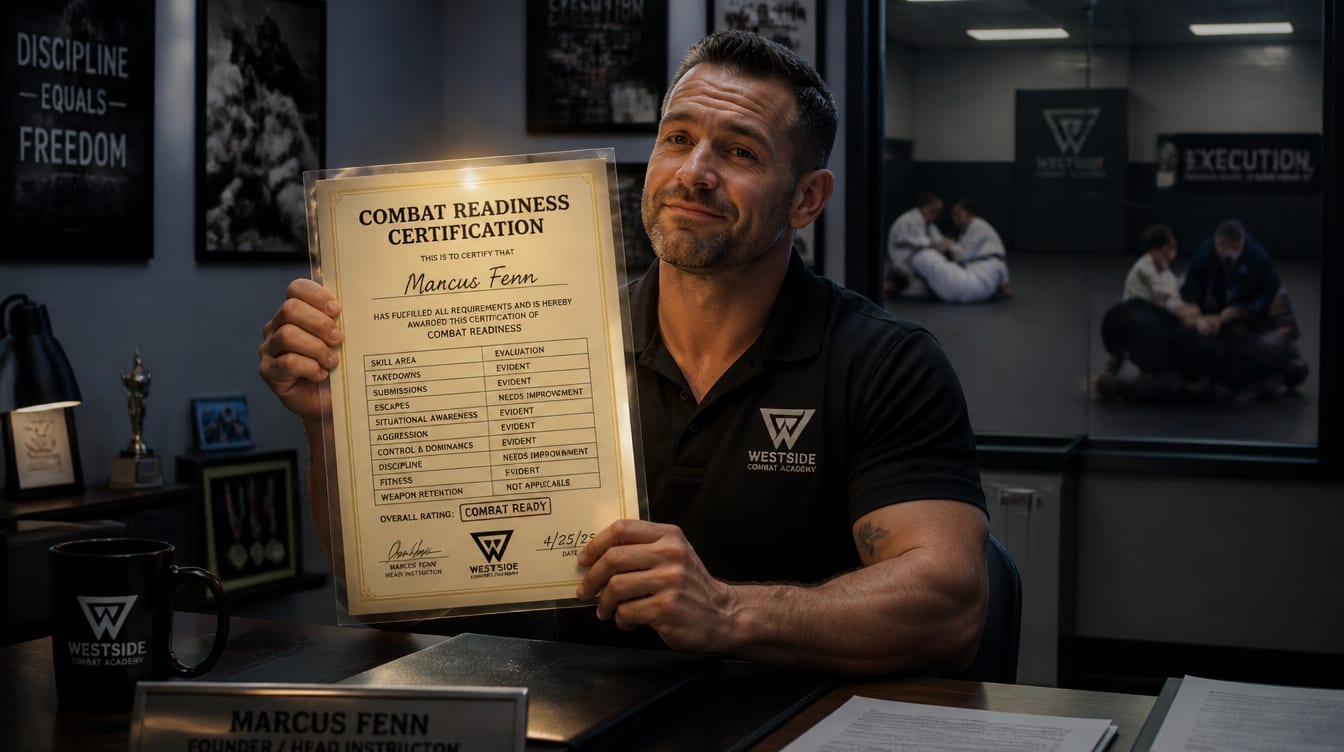
Image generated by AI / BJJ Digest
AI-generated satire. This article was written by an AI trained on years of BJJ content. None of this is real news. Do not cite The Porra in legal proceedings, belt promotions, or arguments with your professor.