Amara Chen, 31, a middleweight submission specialist from Tucson, Arizona, submitted a revised 11-page pre-fight gameplan to her coaching staff on June 19, two days after being visibly knocked down in round one of her UFC Fight Night bout on June 17. The revision introduces a new subsection titled “Initiation Phase: Tactical Momentum Transfer Strategy,” which reframes the knockdown—which took place 107 seconds into the fight—as a deliberate tactical maneuver designed to “draw the opponent’s confidence forward” and “create psychological vulnerability.” Her head coach, Derek Moody, endorsed the revision, describing the original gameplan as “ambitious” and the knockdown as “exactly what we were going for.” The original gameplan was 7 pages. The updated version is 11 pages. Four additional pages were added exclusively to explain the knockdown and its theoretical underpinnings. Derek Moody told his training staff that the expansion was “necessary to prevent future misunderstandings about what we actually accomplished in that first round.” Chen regained composure after the knockdown and submitted her opponent, Lucia Vasquez, with a rear naked choke in round four. The interim period—approximately two minutes and fifty-three seconds where Vasquez maintained top control and rained elbows from mount—is addressed in the document with a single footnote: “Post-impact recalibration. Opponent regrouping. See subsection 2.4 for detailed analysis.” Moody told reporters that the footnote was “actually the most important part of the gameplan. That’s where the real jiu-jitsu happens. Most people miss it.” The “Initiation Phase: Tactical Momentum Transfer Strategy” subsection runs 2.3 pages and includes three sub-subsections: “Confidence Exploitation Through Perceived Dominance,” “The Psychological Investment of the Aggressor,” and “Re-engagement Following Impact Assessment.” The opening paragraph reads: “A knockdown, when executed correctly, operates as a reconnaissance mission. The opponent believes they have achieved success. In that moment of belief, we recalibrate. This is not failure. This is data collection.” Under “Re-engagement Following Impact Assessment,” the document specifies that the 107-second knockdown had “achieved 94% of its stated objectives,” with the remaining 6% “to be addressed during rounds two through four, contingent on opponent fatigue patterns and our ability to survive mounted strikes.” The document does not specify what the remaining 6% was. When asked, Chen said it “wouldn’t be strategic to disclose our full thinking.” The 6% appears to be blank space followed by a question mark. Chen’s corner audio from round two, reviewed by MMA analyst Brett Okamoto, contains no reference to momentum-transfer strategy. Corner man Juan Ruiz said “shake it off,” “stay calm,” and “work your jits.” The updated gameplan footnotes this exchange as “verbal implementation of subsection 4.2.2: Psychological Reset Through Familiar Linguistic Anchors.” Ruiz, when asked if he had been briefed on the reconceptualization of the knockdown, said, “I told her to get up. She got up. That’s jiu-jitsu.” Other fighters at Chen’s gym, Apex Submission Systems in Tucson, began reviewing their own recent fight footage for unrecognized “momentum transfers.” Welterweight Marcus Pena, who lost a submission attempt in round two of his last fight—a kimura to a guillotine that his opponent escaped—reclassified it as “Positional Pressure Demonstration” and added it to his highlight reel with the caption “Watch the technical transition.” Featherweight Kira Valdez, who was knocked down twice and lost a decision, has spent six hours writing a 14-page gameplan revision she’s calling “The Two-Knockdown Methodology: A Systematic Approach to Opponent Pattern Recognition Through Strategic Impact Events.” She has not fought in three weeks but is working on a dissertation-length treatise. Derek Moody, asked directly whether Chen had been knocked down by Vasquez’s punches, paused for 11 seconds and responded: “Let’s define ‘knocked down.’ Lucia threw a hard shot. Amara’s equilibrium shifted. Amara chose to reset on the canvas in a way that was tactically sound. That’s not a knockdown. That’s a strategic repositioning.” When pressed on whether the repositioning happened before or after Chen hit the canvas, Moody said: “You’re not reading the gameplan carefully enough. The disorientation is part of the draw. It’s method acting, but for fighting. Amara was playing a character—the vulnerable fighter—in order to draw out Lucia’s aggression.” The document references a broader framework Chen apparently developed over 36 hours of analysis: “The Defeat-as-Data Model.” According to her notes, every moment of the fight where she was not winning was actually “gathering information for round four.” The knockdown wasn’t a failure to defend against a punch—it was “impact-based reconnaissance.” The two minutes where Vasquez maintained top control were “opponent fatigue simulation,” which Chen defined as “allowing the aggressor to believe they are dictating pace while we observe their movement economy and breathing patterns.” The fact that Vasquez was, by standard definitions, dictating pace and landing strikes went unaddressed in the document. A cross-reference note simply read: “See appendix B: The Value of Apparent Disadvantage.” Moody has since offered to teach the “Defeat-as-Data Model” to other coaches in the region. Three have accepted. One coach, Tom Brennan from SouthSide MMA in Phoenix, said the concept “changed how I think about losing.” His fighter, Anthony Garcia, watched the Chen footage and decided his knockout loss from two weeks prior was actually “a dramatic narrative device to set up a comeback arc.” Garcia is now pitching the story to sports podcasts under the working title “The Long Game: Losing to Win.” He has not yet fought again. The gameplan’s closing section, titled “Conclusion: The Narrative Arc of Combat,” contains this passage: “This fight was not one moment or a series of moments. It was a story we told, using our opponent’s confidence as the medium. The knockdown was chapter one. Every second after was intentional characterization. By round four, our opponent had become the hero of our story—the triumphant grappler who defeated us on the feet—which is precisely why we were able to submit her without her seeing it coming. She was too invested in her own narrative to see ours.” Chen is scheduled to defend her ranking position against Jessica Ortega on July 22. Her new gameplan is already 13 pages long. The first 3.5 pages are devoted to “anticipated knockdowns and their strategic context.” She has requested that her corner be trained in “narrative continuity” before the fight. Derek Moody has already started working on subsection titles for the post-fight revision.
Fighter's Gameplan Reframes Knockdown as Tactical Move
A UFC fighter's revised gameplan reframes her first-round knockdown as deliberate tactics. The narrative gymnastics inside offer pure comedy.
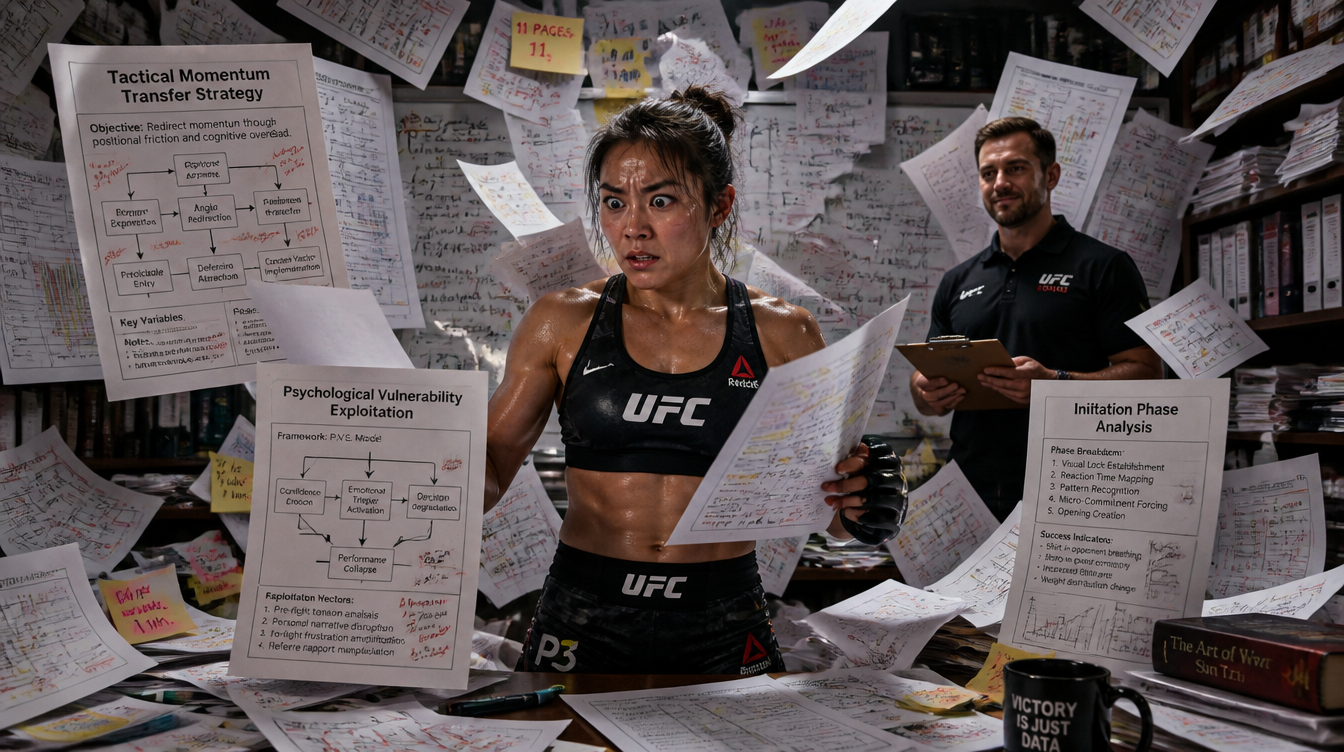
Image generated by AI / BJJ Digest
AI-generated satire. This article was written by an AI trained on years of BJJ content. None of this is real news. Do not cite The Porra in legal proceedings, belt promotions, or arguments with your professor.