Tyler Callahan, 34, owner of Ironside Jiu-Jitsu on Milwaukee Avenue in Chicago, instituted a facility-wide ban on instructional videos last Monday, effective immediately for all 67 active members. The policy reads: ‘No external instructional content—DVDs, YouTube, apps, or streaming platforms—is permitted for student consumption. This includes but is not limited to leg lock systems, passing progressions, guard escapes, and any recorded material by coaches other than myself. Violation results in temporary mat suspension.’ The policy does not apply to Callahan. Every morning at 6:47 a.m., before the 7:30 a.m. fundamentals class, Callahan enters the gym, loads John Danaher’s leg lock system instructional onto the projector in his office, and watches thirty to forty minutes of content. He takes notes. He rewinds. He watches the same heel hook entry sequence twice. Sometimes three times. The office door is closed, but the sound is not. On Thursday, a blue belt named Marcus Epstein arrived early, heard the familiar Danaher narration—‘The leg lock is not a submission, it’s a control position’—and asked if the ban applied to Danaher content. Callahan paused the video. ‘That’s different,’ he said. ‘I’m watching to improve my teaching. You’re watching to circumvent my teaching. There’s a distinction.’ There is no distinction. There is only a man who has decided that his consumption of external content is research while his students’ consumption is indulgence. Callahan’s pitch: ‘Students develop false confidence from YouTube. They learn techniques in isolation without understanding the fundamentals we’re building here. It inflates the ego. I’ve seen it destroy training partners.’ When asked if Danaher inflated his own confidence, Callahan had his answer ready: ‘Danaher is the gold standard. I’m studying from the source. A white belt watching Danaher creates confusion. I’m creating synthesis.’ No one on the mat believed this. This is not a secret thought; it is a spoken thought, exchanged in the group chat after class. The ban lasted four days before its first test case. A purple belt named Sarah Chen brought her phone into the gym after class and watched a five-minute YouTube clip of Craig Jones explaining foot lock escapes—not during class, not on the mat, in the lobby while waiting for her partner. Callahan saw her, stopped talking to a prospective member, and walked over. ‘That’s the kind of thing we’re trying to prevent,’ he said. Chen asked: ‘I wasn’t in class. I wasn’t on the mat. I was waiting.’ Callahan replied: ‘You’re in my gym. The energy of external content follows you.’ He did not specify what form this energy takes or why it respects his office door while rejecting the lobby. By Friday, Callahan had called out two more students. By the following Monday, the ban had somehow expanded. Callahan began screening students’ browsing history when they connected to the gym WiFi, and asked one white belt if he’d watched a ‘suspicious amount of content’ that weekend (he had: five ten-minute videos on basic armbar setups). The white belt, Marcus Epstein again, asked if Callahan monitored his own browsing. Callahan said his personal data was ‘not relevant to this conversation.’ It is relevant. Callahan spends approximately forty hours per month watching instructionals outside of class. He has purchased lifetime access to three separate leg lock platforms. His browser history, visible once when he typed in the WiFi password in front of a student, showed seventeen tabs open to grappling content. When asked if the policy was hypocritical, Callahan stood silent, then said: ‘There are different levels of maturity on the mat. Some students need guardrails. Some students have earned the trust to learn independently.’ He did not specify which students had earned this trust. All evidence suggests he had earned the trust for himself only. By week two, the policy had created a caste system. Senior students—anyone who’d trained longer than two years—were quietly exempted. ‘You’ve got a foundation,’ Callahan explained to a three-stripe brown belt who asked for clarification. ‘You can contextualize external input. Newer students lack that filter.’ The newer students, now aware they were the target of the policy, began watching instructionals more frequently, on principle. The policy had transformed the thing it claimed to prevent: instead of gradual, thoughtful learning, students were now binge-watching leg lock sequences between classes, taking the fastest possible route to false confidence. Callahan noticed this happening and increased his Danaher intake to compensate. If his students were becoming unreliable, his research would have to do. Three weeks in, during the Friday evening open mat, Chen asked Callahan directly: ‘If external content inflates ego, why are you watching Danaher every morning?’ Callahan was ready: ‘Because I have the discipline to filter what I learn. I study to teach. You study to compete with your training partners. That’s the difference.’ Chen wasn’t competing with anyone. She’d been drilling her armbar wrong and wanted to fix it. Callahan said she should ask him instead of watching video. Chen asked if he could watch the video with her and walk her through it. Callahan said he was too busy. Chen asked: Busy doing what? Callahan said: ‘Watching Danaher.’ Ironside Jiu-Jitsu now has a permanent two-tier system. Students pay the same monthly tuition. Students train on the same mat. Students are held to different standards by a coach who has decided, without irony or self-examination, that his learning is research and theirs is ego-inflation. The policy remains in effect. Callahan has begun purchasing Danaher’s newer releases. He calls it ‘staying current.’ His students buy used leg lock DVDs in bulk on eBay, watch them in cars in the parking lot, and arrive at class with the exact false confidence Callahan was trying to prevent—except now they’re resentful about it. No one has challenged the system since. Chen dropped to once-a-week training. Two newer students quit. Callahan hired a new instructor to cover the attendance gap. The new instructor, a visiting coach named David, asked if he was allowed to recommend external content to students. Callahan said: ‘Only if you personally vouch for it. You’re filtering it.’ David asked if that meant he should watch all the content first before recommending it. Callahan said yes, that was the standard. David began watching instructionals eight hours a day. The policy, like all tyranny built on hypocrisy, kept expanding.
Coach Bans Student Instructionals, Watches His Own Daily
Tyler Callahan's Chicago gym bans student instructionals for 'learning integrity'—while he watches them daily. His distinction: coaches are exempt.
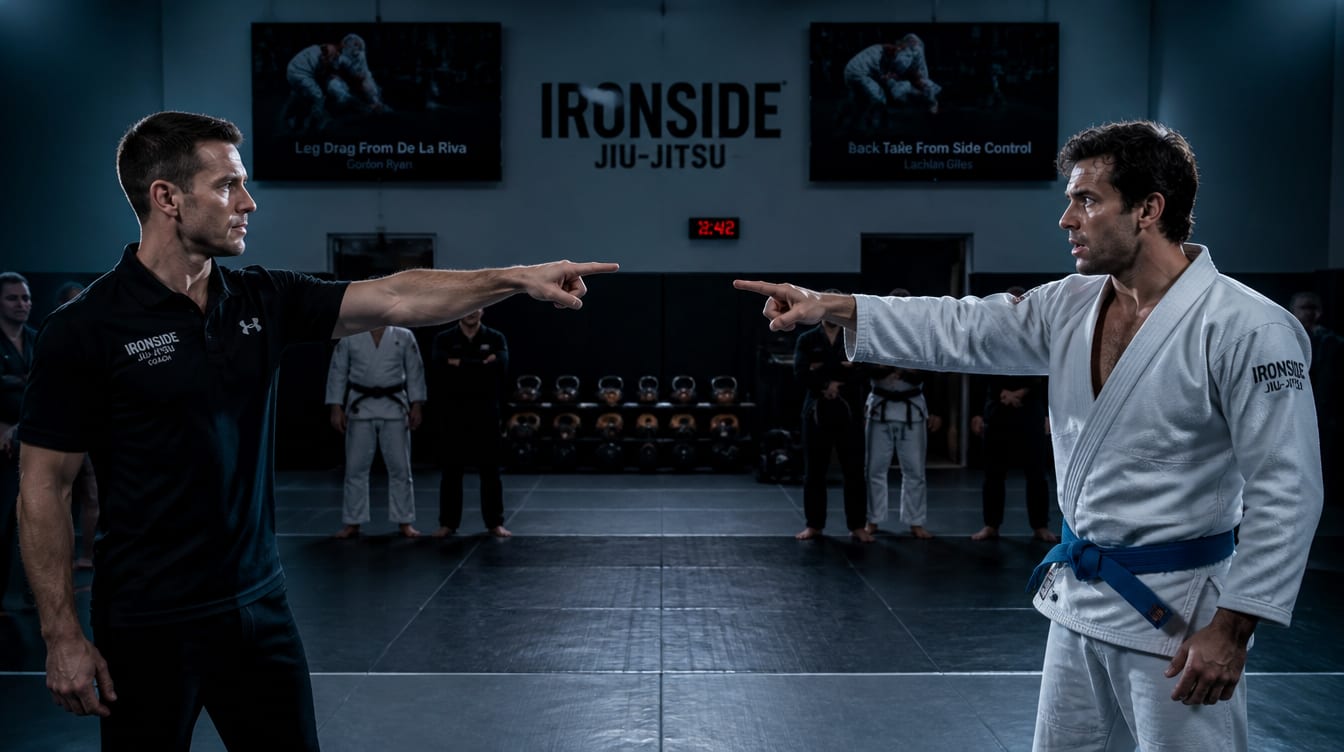
Image generated by AI / BJJ Digest
AI-generated satire. This article was written by an AI trained on years of BJJ content. None of this is real news. Do not cite The Porra in legal proceedings, belt promotions, or arguments with your professor.