Ryan Kellerman, 32, a brown belt at Westside Jiu-Jitsu in Denver, made a decision two weeks ago that felt like a breakthrough. He was scrolling his TikTok For You Page on a Thursday evening when Peak Performance Academy in Boulder, a forty-five-minute drive away, appeared in his feed. The video promised “Modern Jiu-Jitsu Secrets — What Your Old-School Gym Won’t Teach You.” The production value was flawless. The coach, Marcus Webb, was backlit with studio lighting. The mat looked immaculate. The gi colors were coordinated. The background was a tastefully blurred brick wall. Ryan watched. Then he watched another. Then another. Over fourteen days, the Peak Performance algorithm served him seventeen similar videos. Each one showed the same coach, the same professional lighting, slightly different techniques that looked novel because they were shot, edited, and fed to him by the algorithm. Two weeks later, Ryan transferred his membership. He’d been training at Westside—a converted warehouse space with flickering fluorescent lights that buzzed at a frequency that made your teeth ache, and a mat that smelled like it had absorbed every drop of human suffering since 2011—for six years. His old instructor, Coach Luis, had taught him the same guard passes every blue belt learns: the knee slice, the toreando, the smash pass. They worked. Ryan had won three tournaments on them. But Westside was $99 a month. Peak Performance was $299 a month. That’s a $240 monthly difference. That’s $2,880 a year. That’s roughly equivalent to a used motorcycle. That’s definitely more than gas money to Boulder. “Modern jiu-jitsu is different,” Ryan told Luis when he came to say goodbye. Luis, who has been teaching jiu-jitsu for twenty-three years and competed before YouTube was invented, said nothing. He just nodded while wrapping his hands. He’d heard this before. The internet had been telling people that what he’d been teaching was outdated for about eight years now. He suspected it would take another eight years for the algorithm to get bored and tell everyone something new was actually traditional again. At Peak Performance, Ryan arrived for his first class at 7 p.m. on a Monday. The facility had a vending machine stocked with imported açaí bowls ($18 each). The instructors wore matching branded rash guards. The facility manager, Stephanie Chen, greeted him by name—she’d looked up his belt level and previous gym in a CRM system tied to TikTok. The class was taught by an instructor named Derek Vasquez, who taught the same guard passes Luis taught, but said things like “we’re reframing the traditional pass geometry” and “contemporary hip positioning relative to lower limb engagement.” The other students nodded with recognition. They too were here because they’d seen Derek’s TikToks. One of them, a purple belt named Adam, mentioned he’d switched from three other gyms in the past eighteen months, chasing Marcus Webb’s viral content like a man hunting the algorithm’s approval. The second technique Ryan learned was identical to something he’d drilled ten thousand times at Westside. The third was a minor variation that involved rotating your hips a half-inch further—something that made zero mechanical difference but photographed dramatically better from the angle Tanya, Peak Performance’s social media manager, preferred. The fourth technique was literally the exact same thing Luis taught, but Derek positioned his hand differently during the entry grip, a choice that made no mechanical difference but looked different. During water break, Ryan asked Derek about this. “That grip angle is outdated,” Derek said. “But it’s mechanically identical,” Ryan said. “Not for the camera,” Derek said. “Nobody cares what works in person anymore. Everything happens on film now.” Ryan wasn’t sure if Derek was joking. He wasn’t. Derek had genuinely incorporated camera angles and lighting angles into his technical philosophy. When you film something from a 45-degree angle instead of straight-on, the motion appears faster. Apparent speed feels like advancement. Advancement costs $299 a month. By week three, Ryan had measured the curriculum against his Westside notes. The arm drag entry was identical. The knee slice timing was identical. The grip break sequence was identical. The philosophy was identical. But Peak Performance had something Westside didn’t: a professional content operation. Tanya came to classes three times a week with a ring light, a tripod, and a backup ring light in case the first one failed. Every technique got filmed from multiple angles. Every successful roll got edited. Every class became content. Westside had a flip phone in the office and a landline that only half-worked. Luis didn’t have Instagram. Luis didn’t have TikTok. Luis had a 37-year-old curriculum that worked so well that people kept coming back even though the lighting was terrible. Ryan’s old training partners texted him: “Why’d you leave?” “Better instruction,” he wrote back, which was a lie he’d started believing by the third week. By month two, Ryan noticed the Peak Performance community was obsessed with presentation and visual differentiation. They debated which camera angle made Derek’s hip escape look most fluid. They compared his technique videos to his in-person demonstrations and argued about which was “more effective.” The in-person versions were always slightly awkward because they weren’t made for the camera. Nobody mentioned this discrepancy. The in-person versions were mechanically worse—the camera changed priorities. Real jiu-jitsu became secondary to viewable jiu-jitsu became secondary to shareable jiu-jitsu. Ryan started noticing the algorithm at work. Every time he rolled at the gym, Tanya would film his roll from the best angle. His rolls looked better on camera because of the studio lighting. He’d come home to find eight new Peak Performance videos in his feed showing him in the background. The algorithm showed him proof that his new choice was correct. He was a better athlete now. The camera said so. The likes confirmed it. His old gym’s Instagram was dormant. His new gym’s was updated twice daily. He ran into Coach Luis at a smoothie bowl place—not the Peak Performance branded one. Just a regular spot that charged $7. “How’s Peak Performance?” Luis asked. “Incredible,” Ryan said. “The production quality, the community, the—” “The technique?” Luis asked. “Same as what you taught me,” Ryan admitted. “Exactly the same. But they film it better.” Luis stirred his açaí. “The internet runs on attention. Your old gym builds fighters. You’re now in the attention business instead. You’ll eventually notice, but by then you’ll have already reframed it as worth the investment. The algorithm will have convinced you that you’re smarter for paying more.” Ryan didn’t respond. He was already thinking about the Peak Performance branded açaí bowl he’d have for $18 when he got home. He was already thinking about the seventeen new videos he’d have in his feed. He was already satisfied with a system where nobody actually benefits except the people filming it.
TikTok's Gym Secret: $200/Month More, Same Guard Passes
This brown belt switched gyms after a TikTok video and now pays $200/month more for identical jiu-jitsu techniques. Modern gym culture at its finest.
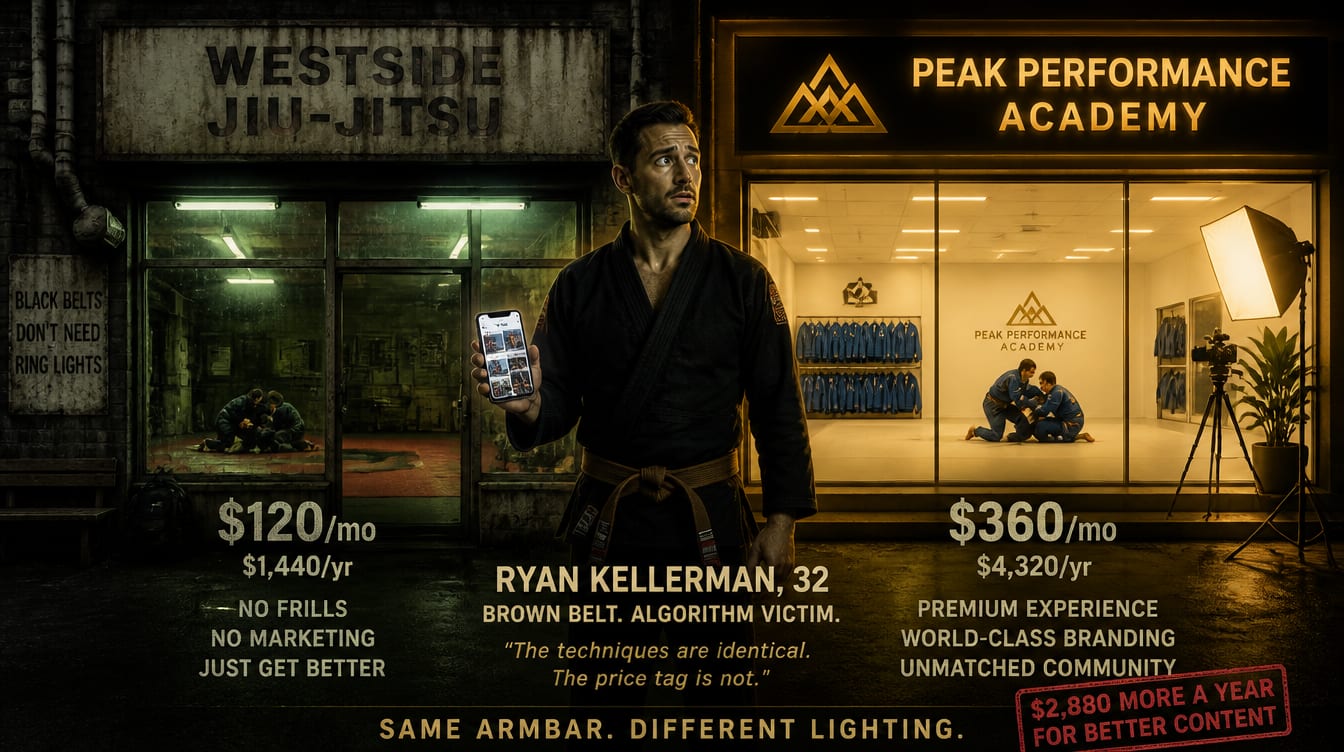
Image generated by AI / BJJ Digest
AI-generated satire. This article was written by an AI trained on years of BJJ content. None of this is real news. Do not cite The Porra in legal proceedings, belt promotions, or arguments with your professor.