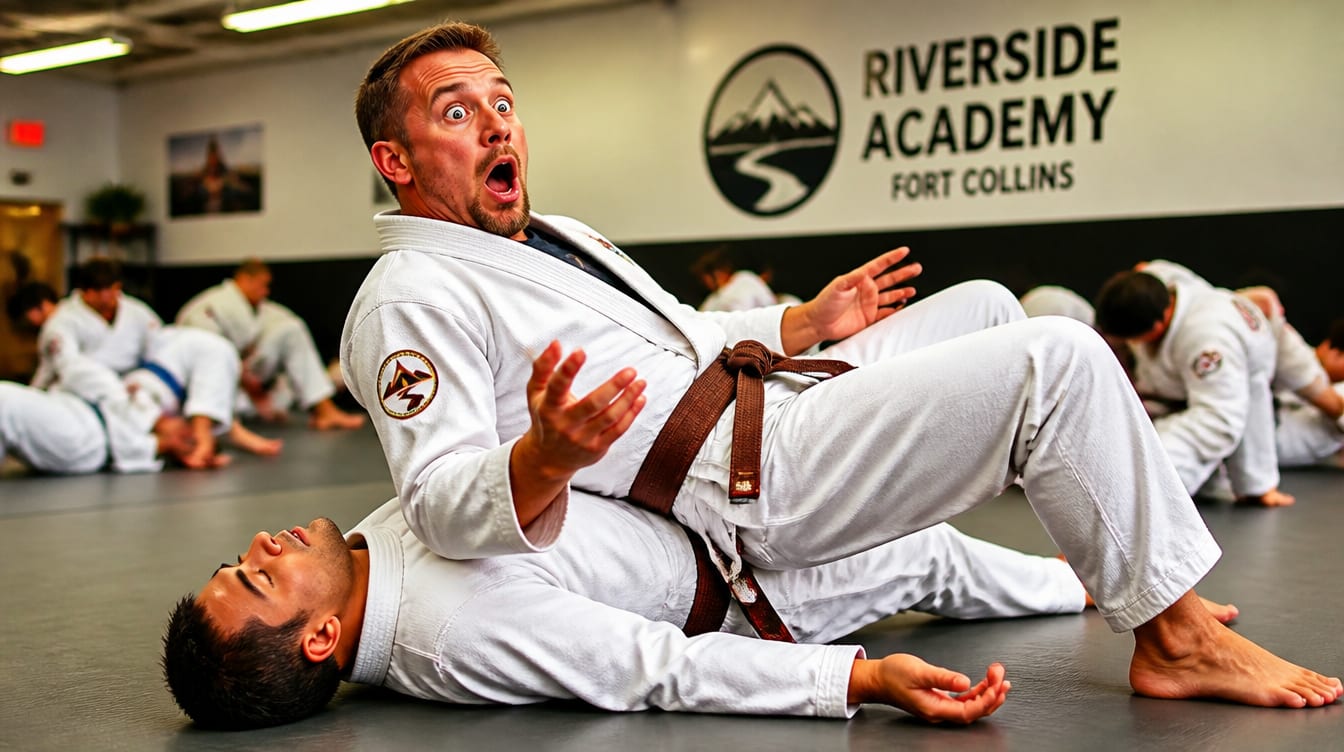
Chris Patterson, 38, opened the “Self-Defense Fundamentals” class at Riverside Academy in Fort Collins just over a year ago with a clear goal: teach people how to escape positions without relying on strength or athleticism. Every technique in his curriculum works perfectly. Every student who completes the course passes the final assessment. Every successful escape gets documented in a video demonstration. The success rate is 100%, maintained across all thirty-seven students in four concurrent sessions.
None of them have ever practiced an escape against someone who actually resists.
Patterson’s signature curriculum focuses on bridging your way out of mount position—a key escape. The technique works like this: your training partner posts both hands flat on your chest, maintaining vertical posture, keeping their weight distributed evenly above you without actually pressing down. You bridge your hips upward using leg drive. They straighten their arms and let themselves get knocked off. You end up on top.
In Patterson’s demonstration videos—and he’s filmed forty-seven—every escape works perfectly. The students practice against partners who’ve been told exactly which escape they’ll see and instructed to hold position and not resist. They don’t tighten their base. They don’t shift their weight. They don’t resist. They definitely don’t actually defend.
“Self-defense is about understanding positions,” Patterson said, working through the escape on Tyler, 22, a student who stayed perfectly still—hands posted, barely breathing—while Patterson finished the demo. “Once you understand the mechanics, the pressure application comes naturally later. Right now, they’re learning the blueprint.”
The blueprint hadn’t yet met reality.

That happened in week seven when Marcus Chen, 24, a blue belt after three straight Tuesday sessions, decided to test what he’d learned at an open mat in Denver. The venue was different. His partner—a white belt from another gym, trained a different way—hadn’t been briefed on how things were supposed to go.
Chen found himself in mount. He tried the escape: bridge, hip drive, arm positioning—the whole sequence. But the white belt didn’t play along. He tightened his base, drove his weight forward, actually defended. Chen’s escape fell apart. Armbar, forty seconds later.
“That guy was way more aggressive than anyone here,” Chen said after class, confused. He wondered whether self-defense gyms were supposed to train with pressure or if the pressure-free approach was standard. The escape had worked every time in Patterson’s class—he’d done it sixteen times. It had to be the other gym’s problem. He hasn’t been back to Riverside since.
Patterson revised his syllabus. “Self-defense is position-based, not pressure-based,” he wrote in an addendum. “Students will master positions first. Real-world application assumes the opponent cooperates with basic positional structure.” It didn’t hurt enrollment. If anything, enrollment went up.
Derek Hollis, who owns Riverside, noticed the surge. Patterson had posted Instagram videos—students demolishing perfect escapes against partners who weren’t resisting, shot in 4K, edited with transitions and motivational music. Over 600 combined views across three posts.
Hollis asked why Patterson wasn’t charging more. Patterson said he’d been thinking about it—the waiting list was forming.

Patterson’s curriculum now included fourteen distinct escape sequences, all with 100% success rates. A perfect record like that deserved a certification program: “Escape Mastery Level 1.”
Students passed by demonstrating three escapes against a cooperative partner in front of Patterson, who graded technical execution. Everyone passed. He’d run eight certifications across two cohorts. He was already working on Level 2—launching September.
One parent, Jennifer Caldwell, signed her 13-year-old son up after reading the tagline: “The only self-defense course where every student passes.” His past sports had been competitive and stressful; he’d never felt good enough. At Riverside, he came home excited. “I passed every test,” he said after the second class. “I escaped five times today. My teacher said I’m a natural.” She liked hearing it. He’s now been six times straight. He still hasn’t faced any actual resistance. According to Patterson’s plan, that doesn’t happen until Level 3—which Patterson hasn’t written yet.
Patterson was recently asked if introducing some actual resistance might help the escapes transfer better to real self-defense. The premise: practicing against pressure teaches skills that transfer better than practicing against partners with no skin in the game. He paused. Then pointed to the library: forty-seven videos. 100% success rate across every technique, every angle, every body type.
“You don’t get those numbers if the technique is flawed,” he said. “You can’t hit this success rate in reality because reality has variables. We’re hitting it here. That proves the technique’s fundamentally sound.”
Classes meet Tuesdays and Thursdays at 7 p.m. Patterson’s now accepting summer applications and thinking about adding Saturday mornings to handle demand. The waiting list: nine people. Pricing starts at $179 per month for four classes, or $199 for eight classes (the Tuesday/Thursday combo, plus Saturday if it opens). Founding Members get a discount: $159 per month.