Tyler Beckman, a 26-year-old insurance adjuster and two-stripe blue belt at Sentinel Jiu-Jitsu in Tucson, registered for the Southwest Regional Grappling Classic on a Thursday night at 11:58 p.m. The tournament was in Flagstaff, Arizona, two hours away. Entry fee: $125. La Posada Hotel, three blocks from the venue: $189 for one night (his coach recommended the historical property, which meant no free parking). Gas roundtrip: $94. New compression sleeves (“recovery tech,” per Amazon reviews he hadn’t read): $47. Vitamin stack from the GNC he passed in the hotel lobby (he wanted to feel professional): $67. Gi replacement—his old one had a small stain on the lapel that only he could see—$325. Total tournament investment: $847. His division’s middleweight blue belt bracket: three matches. His personal victory record after the tournament: three wins. His personal fight record: zero. “The field looked solid,” Beckman said two weeks after the tournament, scrolling through bracket photos on his phone while his training partner Carlos nodded along without making eye contact. “I was genuinely nervous.” The first match was scheduled for 10:47 a.m. Saturday. His opponent, Derek Hutchins, a 24-year-old electrician who trained at Panda Grappling, had arrived at the venue at 10:43 a.m. and headed straight downstairs to the complimentary hotel breakfast. By 10:49 a.m., when Beckman took the mat and stood alone with his hands up, Hutchins was on the third floor in the ballroom picking at an omelet station that had run out of bacon fifteen minutes earlier. He was not, technically, late—he was registered for the Arizona State Qualifier happening 80 miles south in Mesa. He had filled out the tournament registration form on his phone at 11:47 p.m. the night before, autocorrected “Southwest” to “Northeast,” then gave up and guessed. By the time tournament staff reached him at 10:52 a.m., he was already committed to eating his money’s worth of scrambled eggs. He texted back: “Which tournament is this one?” Staff confirmed it wasn’t the one he registered for. Hutchins asked for a refund. They offered him a future event credit. He took it. Beckman advanced by default. “I had this moment where I thought, okay, maybe he’s just late,” Beckman said. “But after like ninety seconds, the ref started pacing.” The second match was scheduled for 1:15 p.m. His opponent, Sean Rojas, 25, a purple belt from Phoenix who worked in commercial real estate, had registered Friday at 11:58 p.m. on his mobile phone while half-asleep. He filled out the form, hit “submit,” and didn’t check his email confirmation. On Saturday morning, he arrived at the venue, checked in at registration, and was assigned to the lightweight division. It took tournament staff 16 minutes of phone calls to discover he’d autocorrected “middleweight” to “lightweight” in his submission. Rojas stood mat-side in the wrong division, wearing his gi, ready to fight someone who wasn’t Beckman 40 feet away in a different bracket. He was refunded $90 of his $125 entry (the “$35 processing fee” was standard, he was told). Rojas disputed it via email for three weeks, then let it go. Beckman advanced again. The third match was the bronze-medal match against Marcus Webb, 23, a white belt from Phoenix who’d driven four hours, paid his entry fee, and booked a room at the same hotel as Beckman. Webb had been training for 14 months at Apex Grappling. At 2:47 p.m., while waiting to compete, he texted his coach: “family thing came up.” His coach forwarded this to tournament staff with no additional context. Webb didn’t return. He was marked withdrawn. Beckman got the bronze medal without stepping on the mat for any of his three matches. Total mat time: 2 minutes 14 seconds (the referee waiting for his first opponent to arrive, then calling time). “I felt good that day,” Beckman told his gym afterward, standing in front of the mirror while putting his gi in the laundry. “Pressure was there. Guard was solid. Matches were weird, but I moved well.” He didn’t move. He stood still. The mat time reflected this. Professor Daniel Vasquez, 47, the black belt coach at Sentinel Jiu-Jitsu, watched the footage in silence. He scratched his beard. He said: “That happened.” He didn’t say anything else. Beckman hung the bronze medal on the wall above his desk at home, next to a framed photo of his younger self in a white gi, smiling. Visitors saw the medal. “Nice hardware,” they’d say. “Thanks,” Beckman would reply. He didn’t mention the $847 investment or the zero fights. One training partner asked, “So you placed third?” Beckman said, “Third’s still placing.” Technically accurate. Emotionally vague. The medal’s wholesale value was $2.40, according to the receipt taped to the box. The ribbon was polyester. The engraving read “Southwest Regional Grappling Classic — Blue Belt Middleweight — 2026 — 3rd Place.” It didn’t read “Unopposed” or “No Matches” or “Cost Per Victory: $847 ÷ 0 = undefined.” Beckman re-registered for the May Southwest Qualifier the following Monday at 9:45 a.m., before his motivation could fade. Entry fee: $135 (up $10). La Posada again: $189. Same hotel, different bathroom (he specifically requested room 347 to avoid the floor with the broken ice machine). New gi: he decided the first one had been fine but needed a new one anyway. $325. Gas: $94. Supplements: he’d bought enough last time, but what if supplements expired? $85. Total investment: $828. Derek Hutchins was also registered for the May event. He texted Beckman on the gym Discord: “Bro I’m actually going to make it this time.” Beckman didn’t respond. He confirmed the trip with his work calendar, blocked the day off, and began planning his driving route to avoid highway construction. He had learned nothing about cost-benefit analysis. He had learned that tournaments were things you went to, that bronze medals were things you hung on walls, and that next time might be different. It wouldn’t be different. But he’d spend another $828 to find out.
Blue Belt Pays $847 to Win Unopposed Bronze Medal
Blue belt from Tucson spends $847 on tournament travel, entry, and gear to win an unopposed bronze medal. The cost breakdown is hilariously detailed.
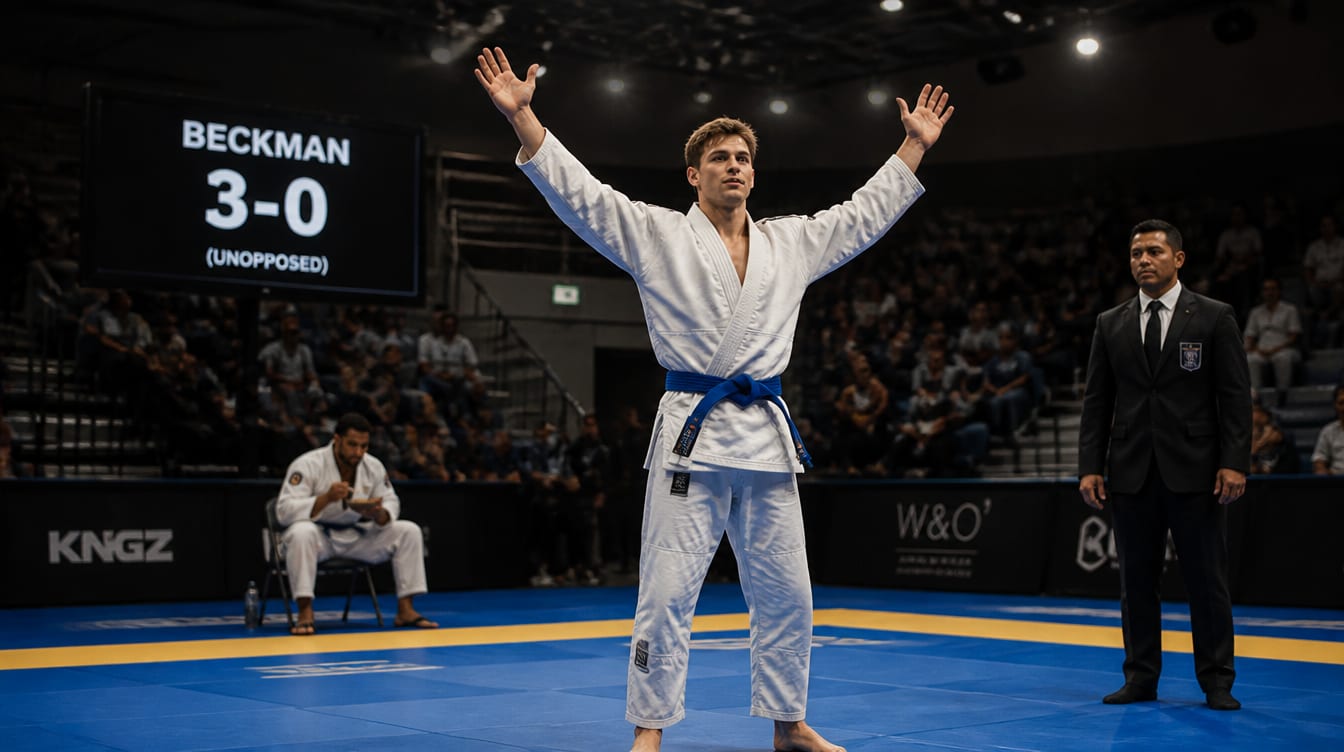
Image generated by AI / BJJ Digest
AI-generated satire. This article was written by an AI trained on years of BJJ content. None of this is real news. Do not cite The Porra in legal proceedings, belt promotions, or arguments with your professor.