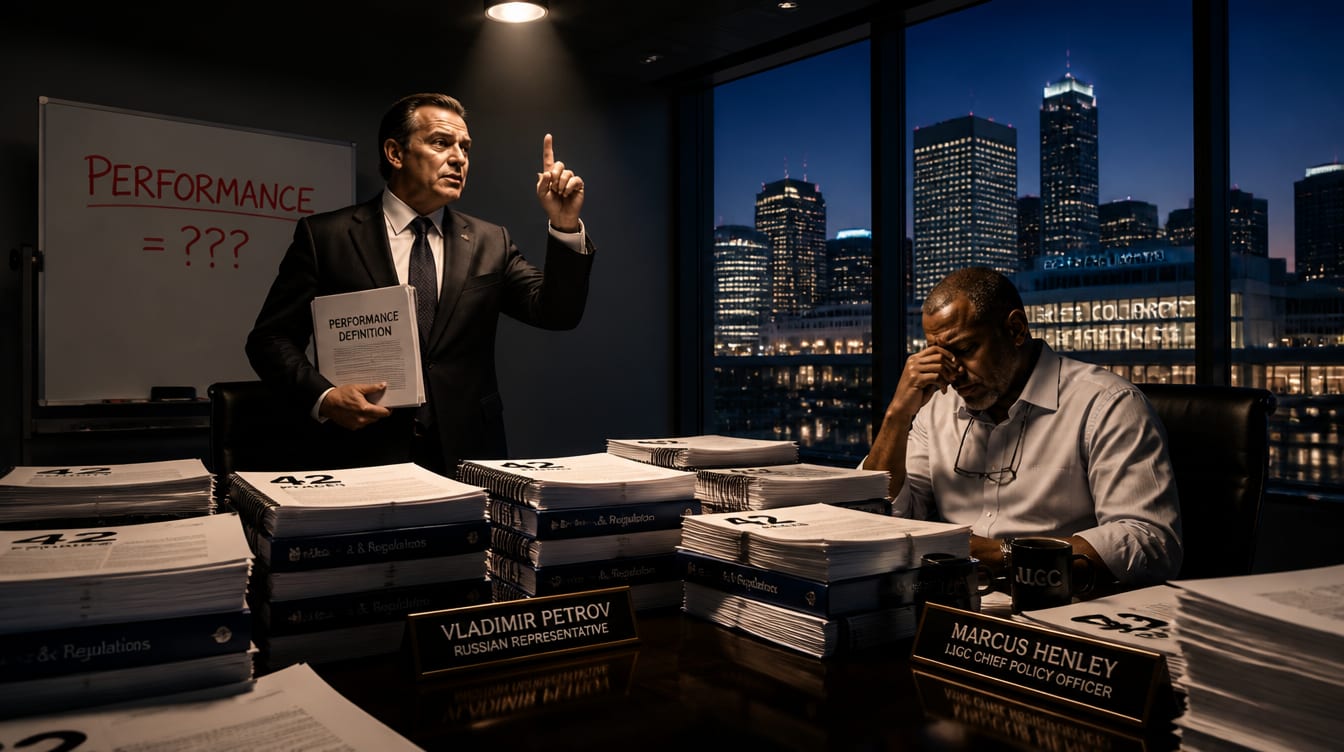
The International Jiu-Jitsu Governance Collective held an emergency procedural meeting Tuesday in Columbus, Ohio, to address what has become the sport’s most intractable crisis: the complete inability of its leadership to determine what, precisely, constitutes a “performance” that might be “enhanced.” The summit was scheduled to begin at 9 a.m. at the Greater Columbus Convention Center. By 11:47 a.m., it had shifted focus entirely from rule-writing to etymology. By 2:15 p.m., delegates had called in a linguistics professor from Ohio State University. By 4:30 p.m., the professor left, citing “epistemological differences I don’t have time to resolve.” By 6 p.m., three delegates were on the phone with Merriam-Webster’s editorial department. The summit is now scheduled to resume “once all parties can agree on what the word Performance means,” according to an official statement released at 11:53 p.m.
“We had the framework ready to go,” said Marcus Henley, 58, the IJGC’s Chief Policy Officer, rubbing his eyes in his Marriott suite on Wednesday morning. “Forty-two pages. Testing protocols, banned substances, minimum suspensions for violations. Then Vladimir Petrov, the Russian representative, asked a simple question: ‘What is the performance that we are enhancing?’ And nobody could answer it. The whole room just… froze.”
The question, innocent on its surface, spiraled into a nine-hour debate that consumed the summit entirely. Does “performance” refer to competitive output (wins, positions, submission time)? Or to the underlying biological capacity (strength, endurance, recovery)? Is a fighter in better cardiovascular condition a “performing” athlete? Or is the cardiovascular capacity itself the performance? Does performance require competition, or can someone enhance their performance while rolling alone in a basement at midnight? If a white belt takes creatine and notices he’s less tired during class, is that a performance enhancement, or just normal human adaptation?
“That’s when Dr. Imani Okafor, the Nigerian medical advisor, brought up a point that broke the entire room,” Henley continued, pulling out his handwritten notes. “She said, ‘In competitive sport, does performance enhancement require competition?’ And then we all realized — does a jiu-jitsu athlete have a “performance” if no one is watching? Is the performance the match, or is the person inherently a performer regardless of audience?”
The room went quiet for 90 seconds. Someone ordered room service. Another delegate began texting their home country’s federation leadership. Within an hour, three separate sub-committees had formed to explore the question.

Committee A, led by Brazilian federation president Jorge Caldeira, 61, a man who has sat on three previous rule-making bodies and seen zero policies implemented, argued that “performance” in jiu-jitsu is exclusively competition-based. “If you’re not fighting, you’re not performing, so performance enhancement is irrelevant to the sport,” Caldeira said, tapping the table with such force his coffee sloshed onto his briefing documents. “A purple belt rolling at their local gym with 80 milligrams of Anavar is not a performer. They are a person who trains. The performance is the match itself. Nothing else counts.”
Committee B, led by American grappling executive Sharon Voss, 44, who’s spent the last six years arguing against every previous policy proposal, countered that this definition excludes training athletes from anti-doping rules entirely, which is absurd from every medical and competitive standpoint. “If an athlete trains year-round to prepare for competition, the training IS the performance,” she argued, gesturing at a laminated chart nobody had asked her to bring. “They are performing in preparation. The preparation is the performance. You cannot have one without the other.”
Committee C, led by nobody specific (they volunteered after the first two committees started arguing in Portuguese), proposed that “performance” be defined contextually — different definitions in different situations, with footnotes and exceptions. This pleased no one but consumed exactly enough time for everyone to check their phones and contemplate career changes.
By 3:45 p.m., delegates had escalated the debate to pure linguistic foundations. Does “performance” as used in anti-doping policy derive from “perform” (to execute, to carry out an action)? Or from “performance” as in theatrical performance (the presentation of a thing to an audience)? If a fighter takes a banned substance but deliberately loses the match, have they violated anti-doping policy? Are they performing, or are they anti-performing? Is the performance the match itself, or is the deliberate loss a different kind of performance? Does intent matter? Can you perform badly on purpose and therefore not be enhancing a performance?
A delegate from Japan suggested they simply adopt the World Anti-Doping Agency’s definition from mainstream sports and apply it wholesale to jiu-jitsu. The suggestion was met with 47 seconds of complete dead silence before the entire Brazilian delegation began laughing in unison — not laughter, but a shared recognition of futility. The Mexican representative, speaking in Spanish, said something that the translator interpreted as “not applicable here,” but later admitted it was something significantly less diplomatic. He declined to repeat it on the record.

In his hotel room that evening, he sent an email to his federation president with the subject line: “We are the only sport.”
By 9 p.m., the committee had achieved consensus on exactly one thing: they needed to break for dinner, and the hotel would not extend catering past 11 p.m. They reconvened at 6:47 a.m. Thursday, having made zero progress, and voted unanimously to adjourn.
The summit’s official press release, delivered at 11:53 p.m. Wednesday, stated: “The International Jiu-Jitsu Governance Collective has successfully identified the foundational challenge preventing the adoption of a universal anti-doping framework. We are pleased to report that our discussions have clarified the nature of the problem. A new summit will be scheduled once all parties can agree on what the word ‘Performance’ means. In the interim, jiu-jitsu remains the only combat sport without a unified anti-doping policy. This is fine. Everything is fine. We will try again in September.”
Marcus Henley was spotted Friday morning at the Cincinnati airport, staring at his phone in the departure lounge. When asked for a comment, he said nothing. When asked again, he said: “We are the only sport where we cannot agree on what the person is doing. Not whether they did it right. Not whether they did it fairly. What they are doing. Period.”
The next summit is tentatively scheduled for September 14, contingent on the formation of a sub-sub-committee to define the word “agree.”