Tyler Caldwell, 28, of Fort Wayne, Indiana, has spent the last 16 months training jiu-jitsu exclusively on one thing: not getting choked. Every private lesson at Ironclad Grappling Academy. Every open mat session. Every solo drill at home. The rear-naked choke, guillotine, anaconda, D’Arce, loop choke, arm-in choke from half guard — Tyler has a verified escape for all of them. He’s drilled them so thoroughly that he can defend a choke in his sleep. He’s also never initiated an attack in his life. His coach, Marcus Webb, 51, asked the question in March 2025 that nobody wanted to voice: “Have you considered developing any offensive technique?” Tyler’s answer was immediate and certain: “If I never get choked, I’ve won.” No additional context. No follow-up. Just that. Marcus stared at him for a solid ten seconds, then said, “Okay,” and walked away. Tyler has since logged 847 total classes and privates. His private lesson count sits at 57. His coach’s private lesson suggestion acceptance rate is currently zero. Webb stopped trying in May and instead spends the first five minutes of Tyler’s open mat sessions standing near him, occasionally shaking his head. The gym has placed a small wager—unofficial, but tracked in the group chat—on when Tyler will finally attack someone. Current odds: never. Here’s the thing: Tyler’s choke defense is genuinely exceptional. Truly. His hand positioning is textbook. His escape timing is better than most black belts. He can slither out of positions that would trap most people. In a sparring match where the sole objective is “don’t get choked,” Tyler would never lose. If that were a sport—and it is not—he would be undefeated. But Tyler has built his entire game around a single contingency. Rolling with Tyler starts optimistically and ends with a kind of philosophical dread. New students think he’s excellent. He lets them pass his guard. They’re amazed at how good he is. Then they establish top position, and somewhere in the process, they realize there’s nothing stopping them from doing anything except their own mercy and a voice in their head saying, “He’s not even defending this. He’s just… letting me win. How am I winning?” His teammate Jason Chen, 24, a purple belt, described rolling with Tyler: “I passed his guard in forty seconds. I wasn’t even trying. Then he started defending chokes. Not my choke. Just every possible way anyone could theoretically choke him. For eight minutes. Then time ended and he told me, ‘Good roll,’ and I left the mat confused about whose victory conditions we were playing by.” Tyler maintains an official rolling record. Not wins and losses—he doesn’t track those because “that’s too reductive”—but rather, escape counts: 12 rear-naked choke escapes, 8 guillotine exits, 4 successful defenses against positional chokes, and so on. His highest single category is “chokes I saw coming and defended before they fully set,” which stands at 34. He has this written in a notebook that he brings to the gym. When asked about his self-defense preparation, Tyler is confident: “Most altercations involve someone trying to choke you. I’m ready for that. I’m extremely ready. If someone tries to put me in a rear-naked choke, we’re going to have a very embarrassing moment for them.” What he doesn’t mention is that a person trying to choke him will also, at some point, probably pass his guard, and then they will probably mount him, and he’ll spend the encounter trying to escape a choke while also scrambling to prevent a mounted armbar, a shoulder lock, a neck crank, or any of the forty other ways an untrained person can hurt someone they have pinned. His offensive game consists of three techniques: staying in guard, staying in guard better, and occasionally getting on his back on purpose because he’d “rather defend a choke from there.” Coach Marcus ran the numbers once. Tyler has thrown 3 submission attempts in 847 classes. Two were Hail Mary heel hooks from a position where he was already tapped. The third was a guillotine that he immediately started defending against. Marcus has not run the numbers again. Tyler’s now considering teaching a seminar at Ironclad titled “The Choke Defense Pipeline: Why Offense Is Optional.” Marcus has already told the gym owner, Derek, to schedule an emergency staff meeting to discuss “educational malpractice liability.” Derek said he’s “not sure that applies here” and “this is the funniest thing happening at the gym right now, so let’s let it play out.” Tyler’s training partner, recently, asked him: “What’s your goal with jiu-jitsu?” Tyler answered: “To never be choked to unconsciousness.” His partner replied: “That’s achieved by not going to the ground with someone trying to hurt you.” Tyler nodded seriously and said, “Yes. But if I AM on the ground with someone trying to hurt me, they will not choke me. I am inoculated against that specific pathway to defeat.” He’s not inoculated against any other pathway. He’ll lose to a pressure pass in four minutes. He’ll tap to an armlock from a position he didn’t even know had an armlock. He’ll be escorted off the mat by an ankle lock, and he’ll tap while somehow still defending against a choke that isn’t even happening. But he won’t be choked. The gym has adapted to this. New students are trained to “roll with Tyler, but set your own victory conditions.” Upper belts avoid rolling with Tyler because the experience is disorienting—it’s like playing chess with someone who refuses to take your pieces but spends forty-five minutes optimizing their queen’s defensive positioning against a checkmate threat from a direction the pieces don’t even cover. Tyler trains next Tuesday, Wednesday, and Thursday. He’s blocked off Friday for “choke defense conditioning.” He’s also considering traveling to seminars, but only if the instructor specializes in “advanced choke escape methodologies.” He’s asked Coach Marcus for recommendations. Marcus said, “No,” and then, after a pause, “Maybe try a different gym?” Tyler’s not leaving the gym. He’s going to perfect his choke defense. He’s going to roll with someone someday who is so confused by his game that they forget to do literally anything else. And in that moment, Tyler won’t get choked. And he’ll have won. That’s how he’s counting it anyway.
16 Months of Choke Defense, Zero Offense: Victory
After 16 months of choke escape training, Tyler perfected every neck defense but never threw a punch. He's convinced he's inoculated against defeat.
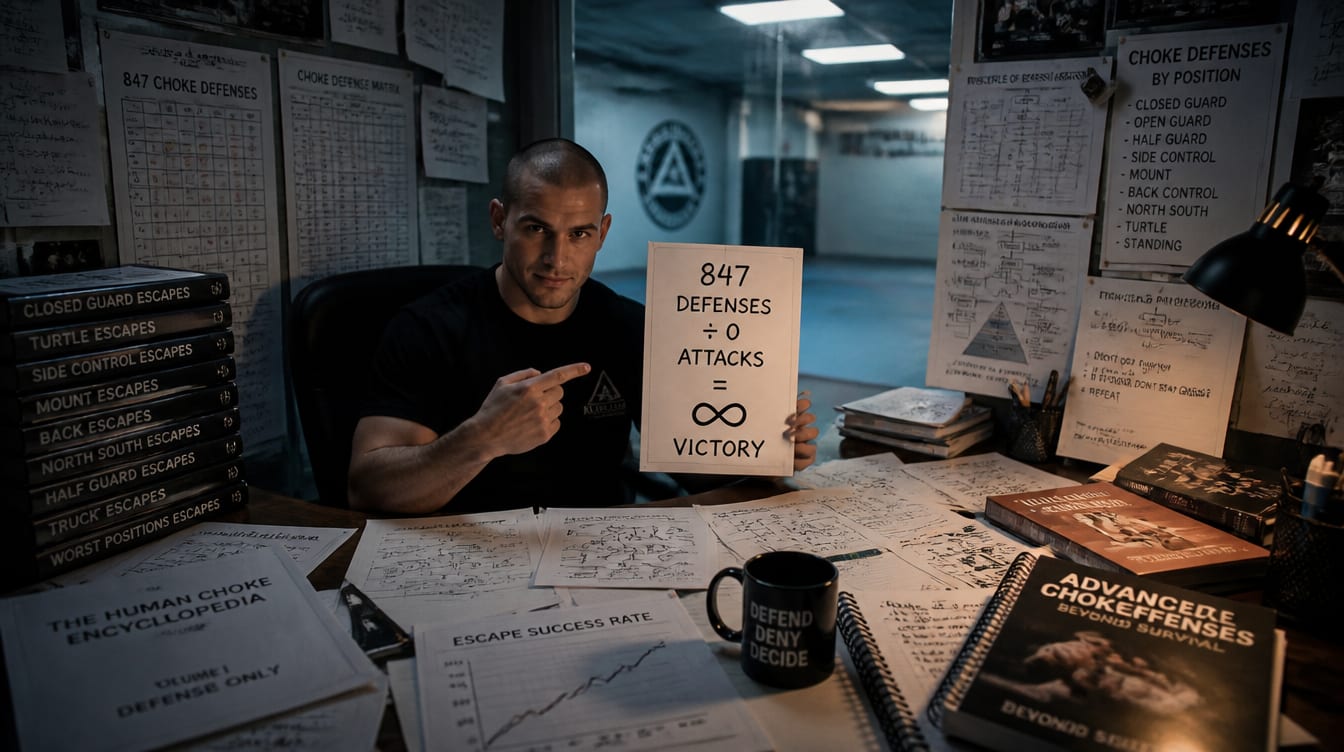
Image generated by AI / BJJ Digest
AI-generated satire. This article was written by an AI trained on years of BJJ content. None of this is real news. Do not cite The Porra in legal proceedings, belt promotions, or arguments with your professor.