Mitchell Caldwell, a 28-year-old purchasing manager from Rapid City, South Dakota, won the Tri-State Regional Jiu-Jitsu Championship on June 18 after losing 47 consecutive tournament matches over four years and three months. He announced his immediate retirement less than six hours later. “I’ve achieved my goal,” Caldwell said at the awards podium, holding the $300 trophy while still wearing his gi. “There’s nowhere left to go but down.” The losses spanned 34 tournaments across five states. Caldwell competed in the advanced intermediate division—a bracket full of people who’d actually won before. His record was 0-47 until Saturday, when he defeated Kevin Okonkwo, a purple belt from Cheyenne, by points in the final match. He then walked off the mat, shook the referee’s hand, and texted his gym owner: “Don’t schedule me for the open mat. I’m done.” Caldwell began his losing streak in March 2022 after his gym, Cascade Grappling, hired a new head coach, Daniel Tremblay, who introduced what he called a “philosophical shift toward positional wrestling.” The previous coach, Frank Deluca, had trained Caldwell in guard-heavy jiu-jitsu. Tremblay’s system emphasized top control and pressure. Caldwell adapted. He learned the new positions. He trained six days a week. By his second tournament under the new system, he was 0-3 in a single day. “I just kept going,” Caldwell explained to his wife, Rebecca, after each loss. Rebecca didn’t ask follow-up questions. The streak held for four years. Caldwell attended tournaments with the consistency of a person attending work. His teammates would see him leave Saturday mornings with his gi bag and say nothing. He competed against people who were better, people who were worse, and people he should have beaten but didn’t. He competed injured. He competed the day after a wedding. He competed hung over on a Sunday in Des Moines after his brother-in-law’s stag party. He never won. Other competitors began to notice. At the Midwest Grappling Collective tournament in Omaha last fall, a brown belt from Lincoln whispered to his training partner while watching Caldwell’s match: “Is he just trying different techniques in live tournaments?” The training partner shook his head. “I think he actually thinks he can win.” By early 2026, Caldwell had dropped $8,740 on tournament entries, travel, and new gis. He had trained under three different coaches—each one convinced the problem was tactical, not fundamental. The third coach, a black belt named Marcus Chen, examined Caldwell’s game and said simply: “You’re fine. You’re just unlucky.” This wasn’t reassuring. Tremblay, the original architect of the philosophical shift, had since moved to Colorado and opened his own gym. When asked about Caldwell’s streak, he said: “I don’t recall that guy specifically, but our system works great. You have to commit.” Caldwell had committed. Commitment wasn’t the variable. Rebecca attended four tournaments over four years, then stopped. She wasn’t unsupportive—she was simply baffled by the whole thing. “He’s so confident every time,” she told a friend. “Like, he actually believes this is the one. And then he comes home and we order pizza and he talks about what he’ll do differently next time.” In May, Caldwell signed up for the Tri-State Regional, the same tournament he’d entered and lost at for three consecutive years. His teammates assumed this was pity—people tend to keep trying the same thing when they’re waiting for the world to change. One of them asked: “Isn’t this the one where you always lose?” Caldwell said: “Probably.” He didn’t lose. The final match against Okonkwo lasted 7 minutes and 40 seconds. Caldwell passed guard in the second minute using a knee-slice he’d been drilling since March. He took side control. He stayed there. Okonkwo, who had won his two previous matches by submission, found himself in a grappling calculus he wasn’t prepared for: Caldwell wasn’t making mistakes. Caldwell wasn’t gassing. Caldwell was simply better organized in that moment. The scoreboard read 6-2 when time expired. Caldwell stood up. Okonkwo tapped him on the shoulder as a courtesy. Caldwell walked to the edge of the mat and sat down. Tournament officials assumed he was taking five minutes before the awards presentation. He was. But during those five minutes, he appears to have made a decision. When they called his name to collect the trophy and shake hands with the tournament director—a woman named Sophia Rodriguez who’d watched him lose there three times before—Caldwell accepted the trophy, smiled for the photographer, and then said into the microphone: “Thank you. I’m retiring.” The crowd made a sound that wasn’t quite applause. Rodriguez held the pause, expecting him to continue. He didn’t. He texted Rebecca: “Won. Retiring. Order pizza.” She texted back: ”???” He called her. “I won one. That was the goal.” “The goal was one tournament win?” “It is now.” By evening, Caldwell’s gym was aware. Tremblay, still in Colorado, saw it on Instagram and sent a message: “Good for him.” Marcus Chen, the black belt who’d told him he was just unlucky, called to congratulate him and ask if he wanted to keep training. Caldwell said he’d think about it. As of Wednesday, he hadn’t committed to a return. Okonkwo, the man he’d defeated in the final, heard the news while reviewing match footage with his coach. He watched Caldwell’s pass again. “He didn’t get lucky,” he said. “He just happened to finally come up against someone worse than him.” “That’s what happens at regionals,” his coach replied. At Cascade Grappling, Caldwell’s locker still has his name on tape. His gis hang there. His teammates haven’t removed them, though it’s been four days. When asked if he’d return to training, Caldwell said: “I don’t want to spoil the ending.”
Tournament Champion Quits After First Win (47-Loss Streak)
Lost 47 consecutive tournament matches over four years, then won once and retired 'at the peak.' A satirical look at competitive ambition and timing.
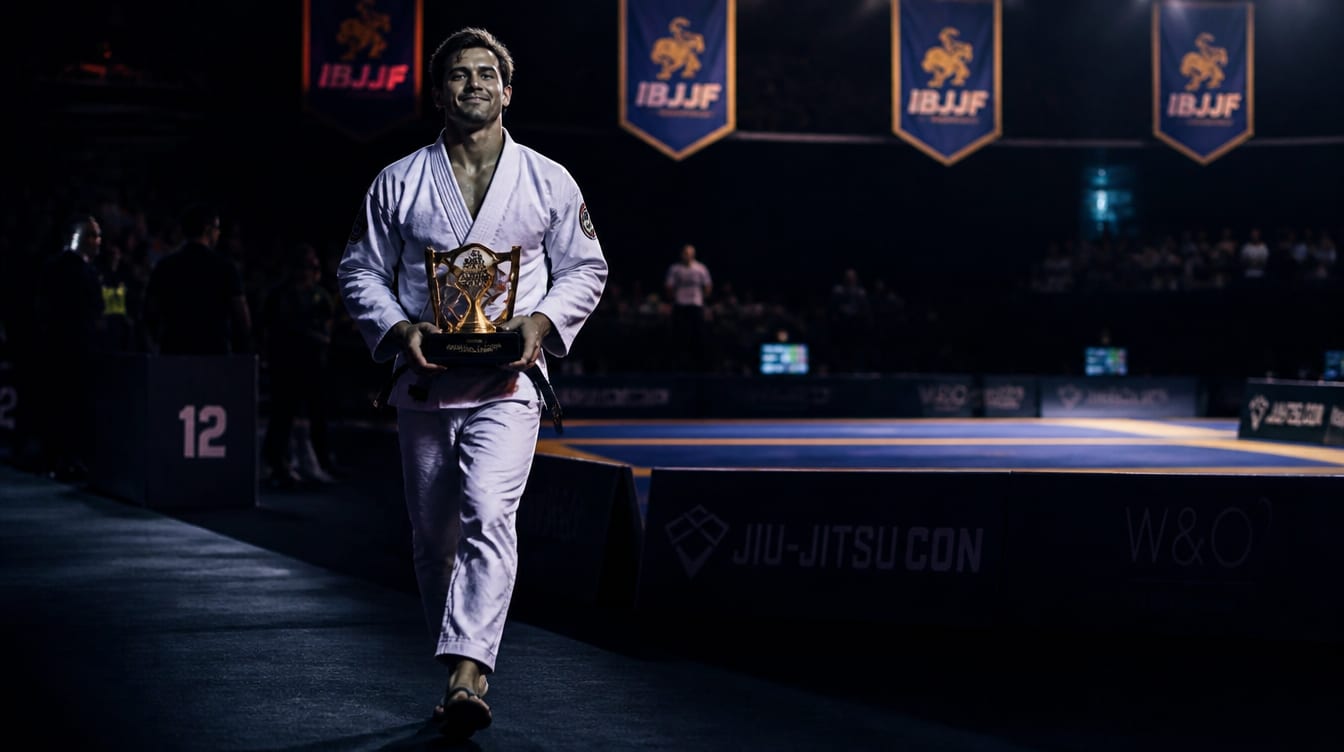
Image generated by AI / BJJ Digest
AI-generated satire. This article was written by an AI trained on years of BJJ content. None of this is real news. Do not cite The Porra in legal proceedings, belt promotions, or arguments with your professor.