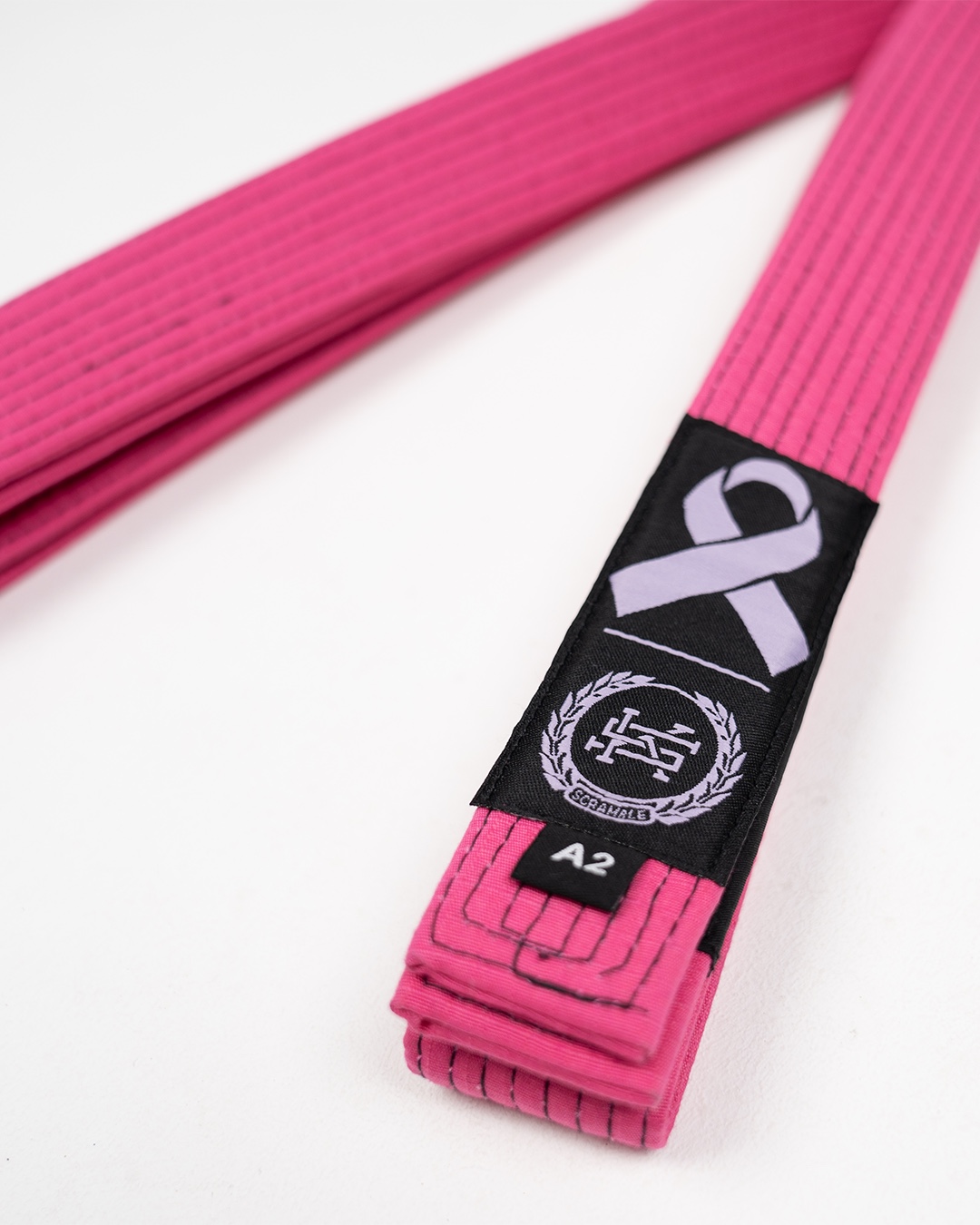
MURFREESBORO, TN — Professor Hector Villanueva introduced the pink belt on a Tuesday in February with the calm certainty of a man who had thought this through.
“You pull guard without trying a takedown,” he told the assembled students at Iron Root Jiu-Jitsu, “you wear the pink for the whole session. Every class. Until I see an honest attempt.”
He had purchased twelve of them online for $8.50 each. He expected to return eleven by March.
It is now May. There are seventeen pink belts in active circulation at Iron Root Jiu-Jitsu. Villanueva ordered a second batch in April. Tyler Gross, a 31-year-old software engineer who has trained at the gym for three years, has not worn his original belt color since February 14th and recently described the pink as “honestly more me.”
The policy, which Villanueva introduced after watching a grown adult blue belt immediately sit down in front of his fourteen-year-old student during a class drill and apparently finding nothing wrong with it, was designed to last two weeks. It was designed, specifically, to produce discomfort.
“The idea,” said Villanueva, 47, a third-degree black belt and former Tennessee state wrestling champion who took up jiu-jitsu in 2001 and has not fully recovered, “was that nobody wants to look like that. That the pink would motivate them to try.”
He paused.
“I underestimated how little they want to wrestle.”
The first week
Students arrived Tuesday, saw the cardboard box on the instructor’s table, and made visible efforts. Double-legs were shot. Trips were threatened. A 44-year-old accountant named Greg Mossberger executed what witnesses described as “a sincere penetration step” before his knee reminded him of a decision he’d made in 2019 and he pulled guard anyway.
He was pinked.
“I tried,” Mossberger said. “I really tried.”

“That’s not a takedown,” said Villanueva. “That’s a thought about a takedown.”
By the end of the first class, six students were in pink. Two of them were genuinely embarrassed. Three of them were using the experience as content for their Instagram stories, which Villanueva found, in retrospect, should have told him something.
The one student who successfully completed a takedown that evening was a 16-year-old named Marcus who wrestled for his high school team and had been training jiu-jitsu for four months. He finished a double-leg, mounted his partner, received a brief round of applause, and looked confused about what he had done to deserve it.
The acceleration
By week three, the attempts had gotten shorter. Tyler Gross’s entry to the guard pull had evolved from a failed single-leg to a forward lean that several students described, generously, as “almost a collar tie.” By week five it was a hand gesture in the direction of the other person’s hips. By week six, Villanueva dropped the grace period entirely.
“If you sit down, you’re in pink,” he announced. “I’m not going to watch you mime a takedown and then immediately flop to the ground like a sea lion. The gesture doesn’t count. The intention doesn’t count. Nothing counts except the takedown.”
Gross was already pink. He accepted the updated terms without comment.
By February’s end, something had shifted that Villanueva hadn’t expected: some students were pulling guard faster now, because the faster you pulled, the less you had to pretend. The pink belt had made it easier to be exactly what it was supposed to shame you out of being.
“I see what happened,” Villanueva said, in the tone of a man who did not want to see what happened.
The community
It was Becca Fuentes, 24, a dental hygienist in her second year of training, who first referred to the pink belt wearers as “us.”
“Us” had, by March, developed its own warm-up corner, a group chat with thirty-one members, and a working set of norms. Pink belt wearers nodded at each other during drills. They gravitated toward each other at open mat. When a new student was pinked for the first time — a nervous 19-year-old named Cole who shot a double-leg, landed on his face, and then pulled guard from the ground — Gross walked over and said, simply, “Welcome.”
Cole has been in pink since March 11th. He has attempted two takedowns since then. Both ended with him pulling guard.
Fuentes, who had pulled guard at a rate of perhaps twice per class before the policy, now pulls guard with a consistency that Villanueva described, carefully, as “her whole thing.” She contests this characterization.

“I know what works for me,” she said, from the floor, where she had been for the past four minutes waiting for her partner to come to her. “The belt just says it out loud. I think there’s something honest about that.”
When asked how Villanueva had responded to this reframe, she said he had “made a face.”
The accessories
In April, someone brought a matching handbag to class.
It was small, pale pink, structured leather, with a brass clasp and a custom patch reading I.R.J.J. — Iron Root Jiu-Jitsu — stitched onto the front pocket. It had been ordered online by Tyler Gross as a birthday present for himself. He carried it to the mat during the warm-up lap. He stored his mouthguard in it. He set it neatly beside the mat during rolling.
Villanueva watched this happen from the far side of the room without speaking.
The following week, three more students arrived with the bags. One, a 38-year-old former art teacher named Dennis Park who had been in pink since the policy’s third day, arrived also wearing a pale pink silk cravat, hand-folded and tucked carefully into the collar of his gi. He had sourced it from a men’s accessories boutique in Nashville. It looked, genuinely, like something.
“I looked into cravats,” Park said. “Turns out they’re historically associated with refined European dueling culture. So technically I’m still a martial artist.”
Villanueva has issued no policy on cravats. He has issued no policy on handbags. He has not, as of press time, issued any policy that has worked. When asked whether the accessories undermine the whole point, he said: “Yes.”
When asked whether he planned to do anything about it, he said: “I’m thinking about it.”
When asked whether, on reflection, the policy had been a success, he was quiet for a long time.
“I wanted them to wrestle,” he finally said. “That’s all I ever wanted.”
Behind him, Dennis Park adjusted his cravat in the reflection of the trophy case, decided it looked right, and pulled guard.