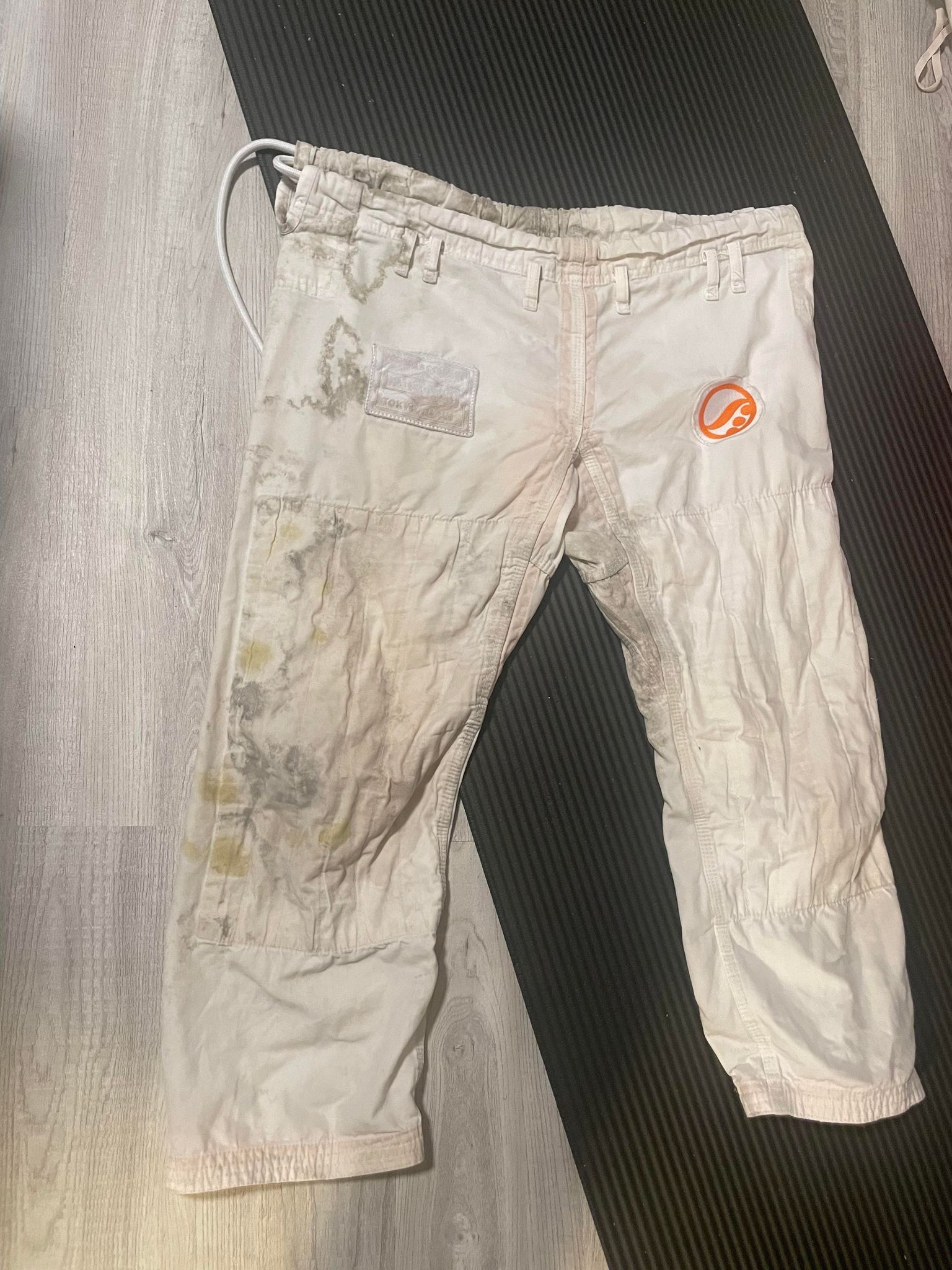
MURFREESBORO, TN — When Austin Reed walked into Ironside Jiu-Jitsu for his first class last Tuesday, he was told the gym had a loaner gi he could borrow. He was not told anything else about it.
“The sleeves ended at my elbows,” said Reed, 27, an account manager who described his first roll in the garment as “medically interesting.” “It was stiff. Not like new-gi stiff. Like a piece of furniture. I didn’t know fabric could do that.”
The gi, which instructors refer to as “the loaner” and long-tenured students refer to as “The Artifact,” is believed to have entered service at Ironside Jiu-Jitsu sometime around 2013. It was white then. It is not white now. The color it has become is difficult to name precisely. “Institutional tan” is the closest approximation offered by anyone willing to study it directly. “Like a band-aid,” said blue belt Derek Malone, who wore it during his first eight months of training before purchasing his own. “A used band-aid.”
The fit has never been correct. The original donor — whose identity has been lost to time, along with the gym’s old sign, two wall mats, and the memory of who used to teach Tuesdays before Coach Ramos — appears to have been a judoka. The sleeves run approximately three inches shorter than any BJJ cut. “You grip the sleeve,” said purple belt Janelle Cortez, “and you’re gripping a wrist.” New students who train in it arrive thinking they are learning wrist control. They are learning to live with impermanence.
The question of washing
There is some debate about whether the loaner gi has ever been laundered. The debate is mostly one-sided.
“Of course it’s been washed,” said head instructor Marcus Webb, 41, a third-degree black belt who has not personally worn the gi since 2019, when he briefly put it on to demonstrate a position and immediately took it off again. “Probably. Somebody washes it. I’m sure someone does.”
No one claims to have washed it.
A canvas banner above the entrance reads WASH YOUR GI AFTER EVERY CLASS. The loaner gi does not train. It simply exists — folded on the bottom shelf of a plastic bin near the bathroom door, developing its character undisturbed, accumulating the ambient humidity of an active martial arts gym the way a coral reef accumulates sediment. Slowly. Permanently. Without anyone’s permission.
Reed, who described the smell as “like the inside of a gym bag that another gym bag has been living in for years,” trained in it for three sessions before purchasing his own. He said this was one of the better decisions of his adult life. He still trains at Ironside four days a week. He does not make eye contact with the bin when he walks past it.
Known wearers
The loaner gi’s alumni list reads like Ironside’s full enrollment history. Among the confirmed wearers: a woman who is now a purple belt and trains five days a week, who said she would “not recommend the experience but wouldn’t take it back”; a man who quit after three classes, though the order of events relative to the gi remains disputed; a competitive blue belt named Greg Park who wore it for eleven months while saving for his first purchase and describes the period as “character-building, in the way that a car accident is character-building”; and one person who, upon being directed to the bin, drove to a storage unit to retrieve her own white belt and A3 top, returned, and trained. She is now a brown belt. She does not discuss this.
Structural integrity
The gi has two documented holes: one near the left shoulder seam, origin unknown, and one in the pants at the right knee, which long-tenured students trace back to a specific incident in 2021 that no one will fully describe.
“It was a heel hook,” said Malone. “That’s all I’ll say. It was a heel hook, nobody tapped fast enough, and then there was a sound.”
The pants have been worn continuously since.
The collar — once stiff and white with sizing — has softened into something approaching fabric art. Three members have described it independently as “biological.” Derek Fontenot, 36, a structural engineer and three-stripe white belt, examined the collar for approximately forty seconds at the start of a Tuesday class, stood up, and walked to the water fountain without commenting. He has not commented since. He has been asked.
The professor’s position
Webb has been asked, on multiple occasions, whether Ironside will retire the loaner gi.
“That gi has a history,” he said. “Every single person who walks through this door for the first time has trained in it. There’s something meaningful about that.”
He was asked whether he had worn it recently.
He said no.
He was asked whether, if required to wear it today, he would.
He was quiet for a moment.
“I’d wash it first,” he said.
He was asked who would do the washing.
He did not answer.
The next chapter
At 6:47 p.m. on Tuesday, a 24-year-old named Chris Navarro arrived at Ironside Jiu-Jitsu for his first class. He had forgotten to bring a gi. He was directed to the plastic bin near the bathroom door.
He reached in.
He pulled it out.
He looked at it for a long time.
“Is this the only one?” he asked.
Webb, across the room demonstrating a guard pass, said yes without looking up.
Navarro nodded. He put it on. The sleeves ended at his elbows. He tightened the belt — which was from a different gi entirely, white, though trending tan — and walked to the mat.
The gi held.
Navarro did not.