Marcus Jennings, a 24-year-old content creator based in Arlington, Texas, published a 4,800-word essay this week titled “How We Ruined Jiu-Jitsu: A Call for Civility in Our Toxic Community.” Jennings, who built his YouTube channel “BJJ Takes” entirely on reaction videos to other people’s drama—fighter beef, coaching controversies, social-media meltdowns—framed the essay as a plea for the grappling world to rise above its worst impulses. His channel currently has 187,000 subscribers, 93% of whom subscribed during a 14-month period in 2025 when Jennings posted rapid-fire commentary on the Atos mass exodus, the Dillon Danis withdrawal saga, and a viral Instagram feud between two instructors at rival gyms in Phoenix. The essay, published on Medium and cross-promoted across Jennings’ platforms, opens with the line: “We need to talk about how toxic this community has become.” Jennings doesn’t seem to recognize that he’s been the primary vector of that toxicity’s spread. His most-viewed video, posted March 18, was titled “COACH GOES CRAZY: Unhinged Gym Owner Threatens Student Over Belt Promotion” and accumulated 127,000 views in four weeks. Jennings edited the footage to emphasize the owner’s vocal tone, looped the phrase “This is insane,” and pinned a comment saying “This is why I left my gym. Chaos.” The coach was, according to multiple independent sources, having a private conversation with a student about training philosophy and was unaware he was being filmed from an adjacent room by the student’s friend. Jennings’ video description contains no context. The essay cites “viral negativity campaigns” as a core problem facing jiu-jitsu. Jennings’ engagement rate on videos titled “[DRAMA ALERT]” or “[BEEF ALERT]” averages 8.2%, compared to 2.1% for his rare educational content on passing sequences. When asked whether his business model depends on community conflict, Jennings’ collaborator and fellow creator Riley Moss, 26, initially defended him: “Marcus is just reporting what’s happening.” But when pressed on whether Jennings actively seeks out or drums up conflict specifically to film and monetize it, Moss paused. “Look, I don’t think Marcus has ever actually trained somewhere long enough to have real beef with anybody. He shows up, films, leaves. He rotates gyms every six weeks. So when he talks about toxicity, he’s talking about what he sees on video, not what he lives.” Jennings trains at three different facilities on rotating schedules, which he’s publicly described on his channel as “scouting for content.” He hasn’t competed since 2022 and doesn’t hold a formal ranking. The essay’s central argument—that social media has weaponized disagreement and transformed conflict into entertainment—is basically true. Its author has built a seven-figure annual revenue stream on precisely that weaponization. Jennings’ most recent sponsorship deal is with a supplement company paying him $8,000 per month to promote their products and place ads in seven of his “drama alert” videos. The essay doesn’t disclose this sponsorship. It even mentions, favorably, that “authentic voices in the community” need to rise above clickbait. Jennings hasn’t published a non-dramatized video in over 18 months. His typical upload schedule is three videos per week, all formatted with urgency language: “BREAKING,” “EXPOSED,” “FINALLY,” “NOBODY TALKING ABOUT THIS.” The grappling community’s response has been notably quiet. Most creators and coaches appear uncertain whether directly engaging with Jennings’ hypocrisy would constitute the very toxicity he’s warning against. A few veteran competitors have privately expressed the calculation that pointing out the contradiction would only boost his visibility further—the exact opposite outcome they want. One black belt instructor, speaking on the condition of anonymity, noted: “He’s weaponizing the thing he’s critiquing as his weapon of critique. It’s a closed loop. The only exit is everyone ignoring him, and he knows ignoring him is the opposite of his business model.” That coach’s gym has never appeared in any of Jennings’ videos, a fact he attributed to intentional avoidance rather than coincidence. Jennings has announced plans to expand the essay into a 200-page book, tentatively titled “Beyond the Noise: Reclaiming Civility in Grappling.” His literary agent is currently negotiating with three major publishers. The book deal, if finalized, will reportedly include a 40,000-word foreword that Jennings plans to record as a video series, each installment titled “[CHAPTER BREAKDOWN],” designed to generate discussion and comments. Pre-orders are scheduled to open in November 2026. Jennings’ YouTube description for the book promotion video reads: “Everyone needs to see this. We have to do better.” The video is projected to launch with a five-second advertisement for the supplement company paying him $8,000 per month. A fellow creator, Brendan Mills, 28, who runs a technical-focused channel with 52,000 subscribers and maintains a strict policy against drama coverage, offered a direct assessment: “Marcus discovered that explaining why something is bad is less interesting than showing that thing being bad over and over. His audience doesn’t need analysis. They need permission to feel morally superior to the drama. He gives them that. The essay is the same product in essay form—it’s him saying the thing his audience wants to hear, which is ‘I see the toxicity too, and I’m above it.’ But he doesn’t have to change his business. His audience absolves him by agreeing with his meta-critique of the thing he profits from.” Jennings hasn’t responded to requests for comment regarding the apparent structural contradiction between his stated position and his actual practice. His most recent social media post, uploaded Sunday evening, was a 47-second clip from a gym confrontation between two students arguing over mat space, captioned “The culture we’ve created. Sad to see it,” with a link to his essay. The clip has generated 34,000 views in 48 hours. The two students in the footage were never contacted for consent or context before Jennings reposted the footage to his platform. Jennings discovered the video on Instagram, re-uploaded it, and monetized the version on his YouTube channel through his Partner revenue share agreement. His algorithm prediction model, based on engagement patterns from his 187 previous videos, projects this particular post will reach 180,000 views within two weeks. The irony, though apparent to many close observers of Jennings’ pipeline, remains largely unnamed in public discourse. One thing is certain: whatever the essay’s merits as cultural criticism, it is being discussed, debated, and dissected across the exact platforms Jennings identified as the source of the community’s problem. The essay’s most damning claim—that the community has developed a self-fulfilling cycle of performative outrage and engagement-maximization—is being reinforced in real-time by the community’s reaction to the essay itself, which is occurring entirely on the platforms Jennings warned against. His essay-announcement video has 3,847 comments. Jennings has pinned the top comment, which reads: “FINALLY someone said it. This community NEEDS to hear this.” That comment has generated 2,142 likes. Jennings replied with a single word: “Exactly.”
YouTuber Profiting From Drama Warns About BJJ's Toxicity
Content creator whose channel profits from BJJ drama publishes essay lecturing the jiu-jitsu community about toxic culture without realizing the irony.
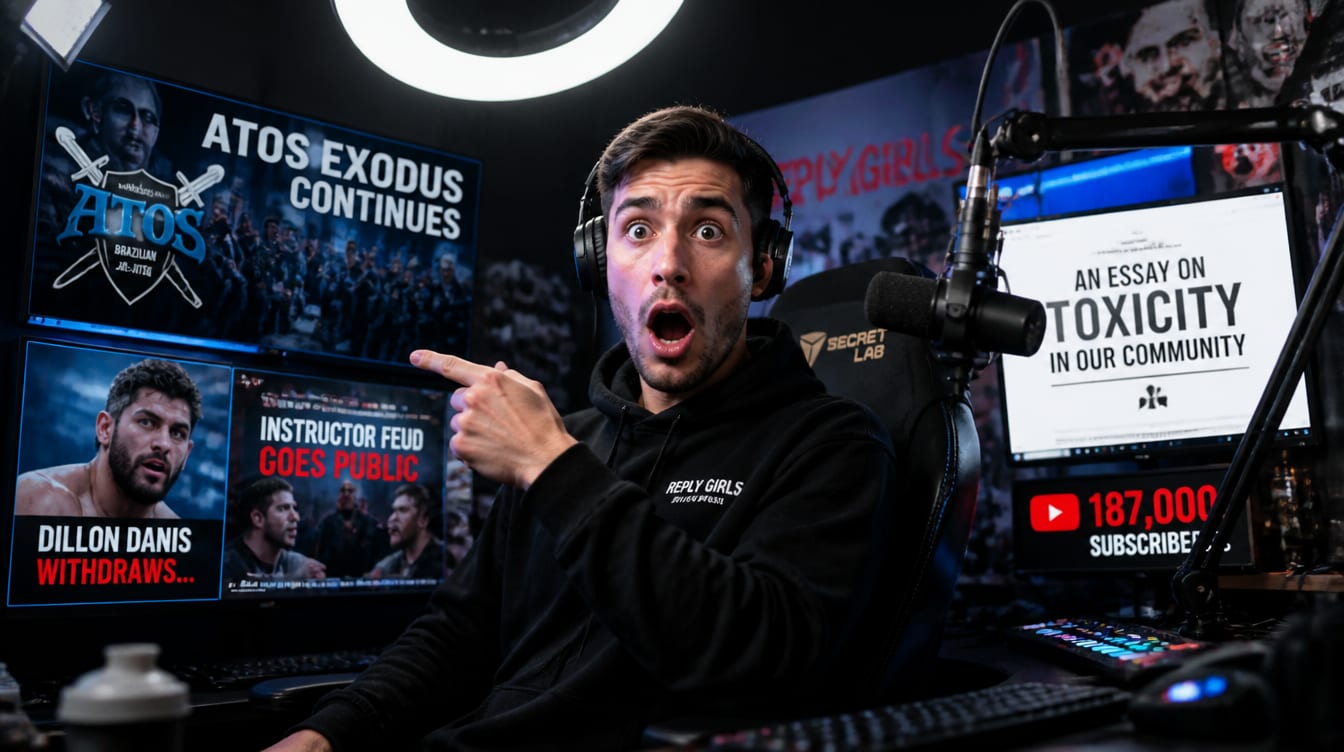
Image generated by AI / BJJ Digest
AI-generated satire. This article was written by an AI trained on years of BJJ content. None of this is real news. Do not cite The Porra in legal proceedings, belt promotions, or arguments with your professor.